
Most organizations are one layer deep into AI adoption and wondering why AI engineering productivity gains don’t match the promise. The framework for understanding why is actually simple, and one you’ve heard before: you have to slow down to go faster. The trick is to build on success.
Gorilla Logic has spent more than 20 years guiding engineering leaders and Fortune 500 companies through waves of technological shifts that have turned traditional ways of working upside down. AI is the same story with a new, flashier name and problem set. Everywhere you look, you are hearing about 100X solutions with little measurable proof or results to back up the claims.
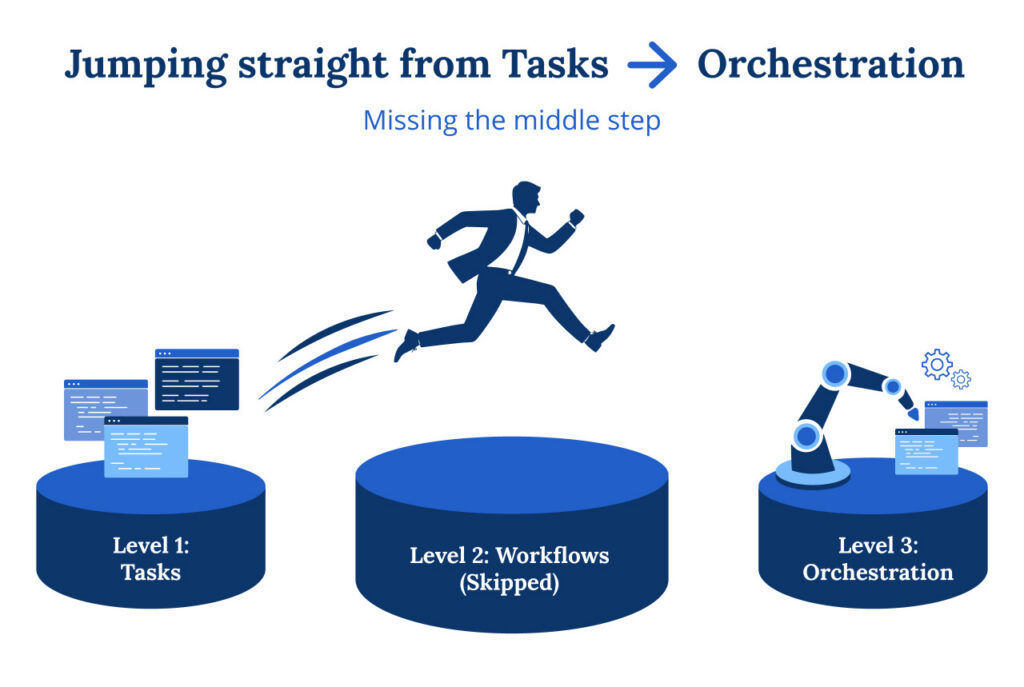
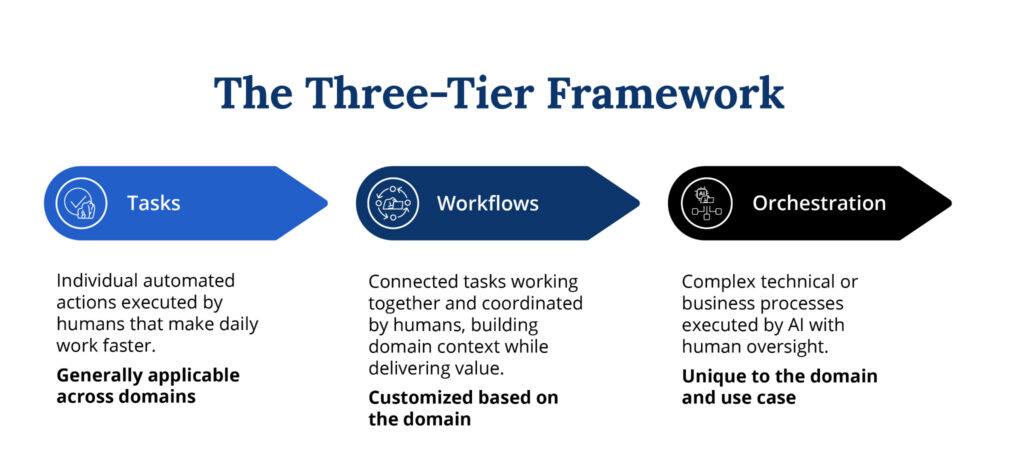
If you stop reading this article and take one thing away, let it be this: AI engineering productivity does not improve all at once. It evolves in three progressive layers: Tasks, Workflows, and Orchestrations. Instead of simply applying AI to each level, you need to redefine and deploy new ways of working with AI. Not AI layered on top of the same work your team is already doing.
Let’s start by looking at the first layer and how teams can build on early wins at the Task level.
Layer 1: Task-Level Acceleration
It would be logical to assume most organizations start here. In practice, they don’t.
What we see instead is fragmented experimentation, teams using AI in isolation or attempting to automate complex workflows before establishing consistency at the task level.
At its core, this layer is simple: apply AI to repeatable, high-frequency activities like pull request reviews, test case drafting, code suggestions, and meeting summaries.
When done deliberately, tasks that used to take an hour take twenty minutes. Developers get back mental bandwidth they didn’t realize they’d lost.
The AI engineering productivity gains are real. In some cases teams see 20–40% faster execution on specific tasks. That’s not nothing.
But it has a ceiling, and most organizations hit it faster than they expect. If the handoffs between teams are still slow, if QA cycles are still manual, if requirements still arrive incomplete, then all that individual speed just creates a new kind of waiting. The work piles up somewhere else in the system. Task-level AI is the foundation, but stopping there means the building never goes up.
Layer 2: Workflow-Level Optimization
This is where productivity starts showing up in metrics that actually matter to the business.
The shift is conceptually simple but organizationally hard: instead of using AI to help individuals do their jobs faster, you redesign how work moves between people and systems. Backlog refinement connects to story breakdown and sprint planning. Code review connects to automated validation. Test generation feeds directly into QA pipelines. Incident detection routes intelligently rather than sitting in a queue.
When AI operates across these connected activities, something different happens. Cycle time comes down. Rework decreases because context stops getting lost at the handoff points. Teams spend less time figuring out where things stand and more time moving them forward.
This is the layer that most AI strategy conversations skip past too quickly. It’s less exciting than talking about agents and orchestration, but it’s where the majority of practical, near-term velocity improvement lives — and it’s the necessary foundation for what comes next.
Layer 3: System-Level Orchestration
Layer 3 is genuinely different in kind, not just degree. This is where AI stops assisting humans with individual tasks and starts coordinating processes across the organization.
Consider what a complex incident response looks like today in most engineering environments. An alert fires. Someone gets paged. They start digging through logs across multiple systems, trying to reconstruct what happened, figure out what’s affected, and determine who needs to know. It might be thirty minutes before the right people are even in the room. Another hour before there’s a clear picture of the root cause.
At the orchestration layer, AI agents monitor those logs continuously, identify anomalies, surface likely root causes, route the issue to the right team with relevant context already assembled, and in some cases recommend or trigger remediation steps automatically. What used to take two hours of stressful, manual coordination can compress into minutes. Mean time to resolve drops dramatically — not because engineers got smarter, but because the system stopped waiting on humans to do things humans were never good at anyway.
The same logic applies to multi-team deployments, legacy modernization, large-scale platform updates. At this layer, the gains aren’t incremental. They’re structural.
AI Engineering Productivity: Why Most Organizations Never Reach Layer 3
Getting from Layer 1 to Layer 3 isn’t a technology problem. The tools exist. The harder challenge is that each layer requires a meaningfully different kind of organizational commitment than the one before it.
Layer 1 can be rolled out as a tool adoption initiative. A team lead sends a Slack message, licenses get distributed, developers experiment on their own. The coordination cost is low, and so is the ceiling.
The jump to Layer 2 is where most organizations stall — not because the concept is hard to grasp, but because workflow redesign requires people to agree on how work should flow differently across functions. Product managers, QA leads, DevOps engineers, and engineering leadership all have to be in the same conversation, with someone accountable for driving it to a conclusion. That’s a different kind of project than deploying a tool, and it tends to lose to other priorities unless there’s explicit leadership sponsorship.
Layer 3 adds another layer of complexity still. AI agents making routing decisions or triggering deployments need governance — guardrails, security review, clear escalation paths for when the system gets something wrong. The measurement frameworks need to be mature enough that you can trust what the system is optimizing for. None of that happens organically.
The underlying reasons organizations get stuck — measuring adoption instead of outcomes, underestimating the change management involved, deploying tools without a strategy for workflow redesign — are worth understanding in detail before trying to move up the stack. If those foundational challenges sound familiar, Part 1 of this series covers them in depth, including why the gap between AI adoption and measurable product velocity is wider than most leadership teams realize.
The AI Engineering Productivity Maturity Model
The path from experimentation to transformation is not random.
It follows a progression:
The organizations reporting meaningful productivity gains are not simply “using AI more.”
They are applying it more strategically.
The Strategic Implication for Engineering Leaders
The honest diagnostic question isn’t “are we using AI?” It’s which layer the majority of your AI activity is actually operating at — and whether that matches where you need to be to hit your business goals.
Most organizations, if they’re candid, are deep in Layer 1 and dabbling in Layer 2. That’s a reasonable place to be in 2024. In 2026, it’s a competitive liability.
The companies that will pull ahead aren’t the ones with the most AI licenses or the highest developer adoption rates. They’re the ones that have done the harder work of redesigning workflows and building toward orchestration. The productivity gains at those layers don’t just add, they compound. And compounding, by definition, rewards whoever started first.
This article is based on a recent conversation between Drew Naukam, our CEO, and Bob Graham, our Chief Growth Officer. You can watch the full discussion here.