

Walk into almost any portfolio company leadership meeting today and you’ll find the same tension: AI in private equity has been written into the investment thesis, the velocity targets are set, and the expectation of 5x or 10x productivity gains is sitting on the table. The engineers know what the tools can actually do. And the gap between those two realities is where execution quietly falls apart.
The tools were never the hard part. The hard part is the planning that should have preceded them, and that conversation is playing out across the market at scale.
What Firms Are Actually Underwriting
The velocity mandate is real, and it sits at the heart of how AI in private equity is being underwritten today. Scott Darby, board member at Gorilla Logic with deep experience advising private equity firms and their portfolio companies on technology execution, describes encountering investment theses where development output targets are set at multiples of current baselines, with AI cited as the mechanism that bridges the gap.
That ambition isn’t wrong. The productivity gains from well-implemented AI are genuine and, in the right conditions, significant. But the phrase “well-implemented” is doing a lot of work there. Most organizations are nowhere near those conditions when the underwriting happens. The gap between what AI can theoretically enable and what a specific organization can actually deliver with it is almost never part of the model.
When that gap gets ignored at the thesis stage, it shows up as pressure at the operating level: targets that teams don’t know how to hit, initiatives that stall after early gains, and a growing disconnect between what the board is expecting and what the engineering organization is experiencing.
Why AI Gains Stall in Private Equity Portfolio Companies
The typical pattern of AI adoption inside a portfolio company follows a recognizable arc. Copilots, code generation, and documentation assistants are introduced. Early results look promising: developers are faster on certain tasks, some manual work gets automated, and the productivity numbers from the pilot look good in a slide deck.
Then momentum slows.
Not because the tools stopped working, but because the tools were never the constraint. The constraint was always how the organization decides what to build, how it sequences and prioritizes work, how it handles technical debt that slows every cycle, and how tightly its delivery process is coupled to legacy systems and habits. AI layered on top of those constraints doesn’t remove them. In some cases it makes them more visible.
Scott puts it plainly: when AI expectations aren’t grounded in how work actually gets done inside a company, they end up “slightly detached from reality.” That detachment is where execution failures are born.
AI amplifies the operating model it’s placed into. If that model is well-designed with clear prioritization, strong product leadership, and a clean enough architecture to move quickly, AI accelerates it dramatically. If the model is fragmented, AI accelerates the fragmentation. What it cannot do is substitute for the organizational fundamentals that determine how well work gets done.
AI Is Not the Strategy
One of the most common misconceptions is treating AI as the strategy itself. AI is an enabler, and a powerful one, but it does not replace the fundamentals that drive performance.
Organizations still need:
- Strong product leadership
- Clear prioritization and alignment
- Scalable architecture
- Disciplined engineering practices
Without these elements, AI tends to amplify inefficiencies rather than eliminate them.
This is why many early AI initiatives stall. Not because the technology lacks capability, but because the operating model has not evolved to support it. For AI in private equity to drive real returns, the organizational fundamentals must come first.
From AI Adoption to AI-Driven Execution
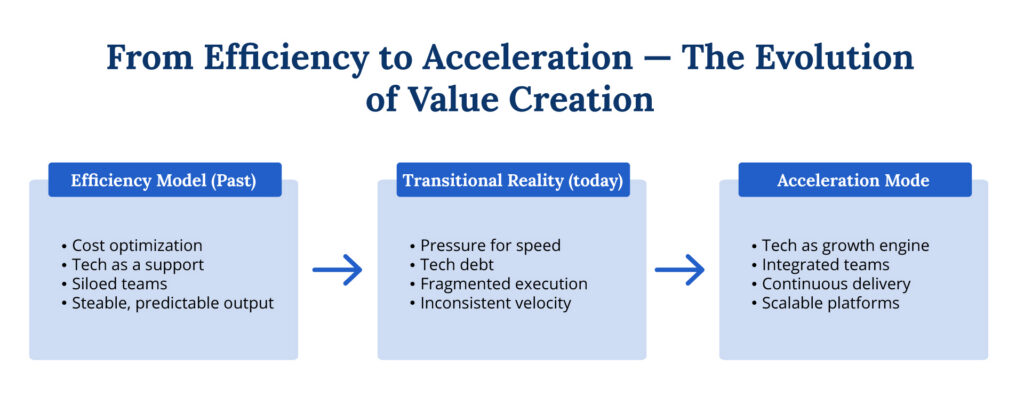
AI creates meaningful value when it is integrated into the operating model, not when it is applied as a standalone tool.
Where AI in Private Equity Actually Delivers Measurable Value
Despite the challenges, organizations that apply AI with precision are seeing meaningful results. Not across everything, but in specific, high-impact areas.
The most effective use cases tend to be operational:
- Automated testing and QA acceleration
- Code generation and refactoring
- Back-office process automation
- Documentation and system understanding
These are not headline-grabbing transformations, but they are measurable. They improve cycle times. They reduce manual effort. And they create the foundation for broader acceleration.
As highlighted in Gorilla Logic’s approach to AI-enabled engineering, structured workflows and reusable patterns can significantly reduce engineering effort while improving consistency and quality.
The key is not applying AI everywhere. It is applying it where it drives immediate, compounding impact.
The Case for External Expertise (Done Right)
One of the harder truths for organizations facing aggressive velocity targets is that they’re often being asked to move faster than their internal capabilities allow, a gap that reflects how quickly the AI landscape is moving and how much organizational change is required to capture its benefits, rather than anything about the competence of the people involved.
The instinct in some firms is to push internal teams harder or add headcount. Neither tends to solve the underlying problem. More people in a broken process creates more coordination overhead. And internal teams attempting to redesign how they work while simultaneously meeting delivery expectations almost always sacrifice one for the other.
What works better is targeted external partnership — not outsourcing, which transfers ownership without transferring capability, but genuine capability transfer. The distinction matters. The goal isn’t to have someone else execute the AI strategy. The goal is to bring in experienced teams who can accelerate the initial build, introduce proven workflows and engineering patterns, and uplevel the internal team so that the organization exits the engagement operating at a higher level than it entered.
This is the model that produces lasting change: external expertise that’s designed to make itself unnecessary.
Turning AI in Private Equity from Experimentation to Operating Discipline
The companies that are extracting the most value from AI share a characteristic that has nothing to do with which tools they’ve chosen. They treat AI as an operational capability (something that requires clear ownership, defined processes, measurement infrastructure, and continuous refinement) rather than an innovation initiative that sits outside the core business.
That means establishing explicit alignment between AI use cases and business outcomes before deployment, measuring impact at the operational level and treating AI adoption as an ongoing discipline with continuous refinement rather than a project that closes when the rollout is done.
Private equity’s defining constraint is time. A 12–24 month window to establish trajectory doesn’t accommodate open-ended experimentation. Organizations that define where AI fits, what success looks like, and how they’ll know if it’s working can move quickly. Those that don’t spend that window exploring without delivering which, in a time-bounded hold period, is effectively the same as not moving at all.
The firms that will realize the most value from AI in private equity won’t be the ones that adopted it first, they’ll be the ones that applied it with enough discipline to make it show up in the numbers.
This post is drawn from a fireside chat between Scott Darby, Gorilla Logic board member, and Drew Naukam, Gorilla Logic’s CEO. They go deeper on AI adoption, velocity targets, and what portfolio companies are actually experiencing on the ground. Watch the full conversation here.