


Most engineering teams treat AI adoption as a speed problem. Gorilla Logic decided to treat it as a sequencing problem, and built an AI delivery system that proves it. That single shift is what makes AI Factory different.
Every engineering organization reaches the same inflection point: interest in AI is high, experiments are everywhere, and yet nothing sticks. Some engineers use GPT, others Copilot, Cursor, or Claude Code. A few teams find real value, but the knowledge stays trapped inside personal prompts, partial playbooks, and one-off experiments that are hard to trust, hard to transfer, and even harder to measure.
AI Factory was built to change that; it changes that story by turning AI enablement into a structured AI delivery system. The success story now taking shape is not a giant platform launch. It is something more meaningful: engineers who can take small AI use cases, package them safely, reuse them across teams and repositories, and translate the gains into measurable customer value.
Most importantly, AI Factory is not being positioned as a shortcut around engineering fundamentals. It is the execution layer of a broader enablement model: learn first, pilot small, review in public, package what works, and scale to the client only when the workflow is clear, minimal, and safe.
Before AI Factory: the real engineering problem
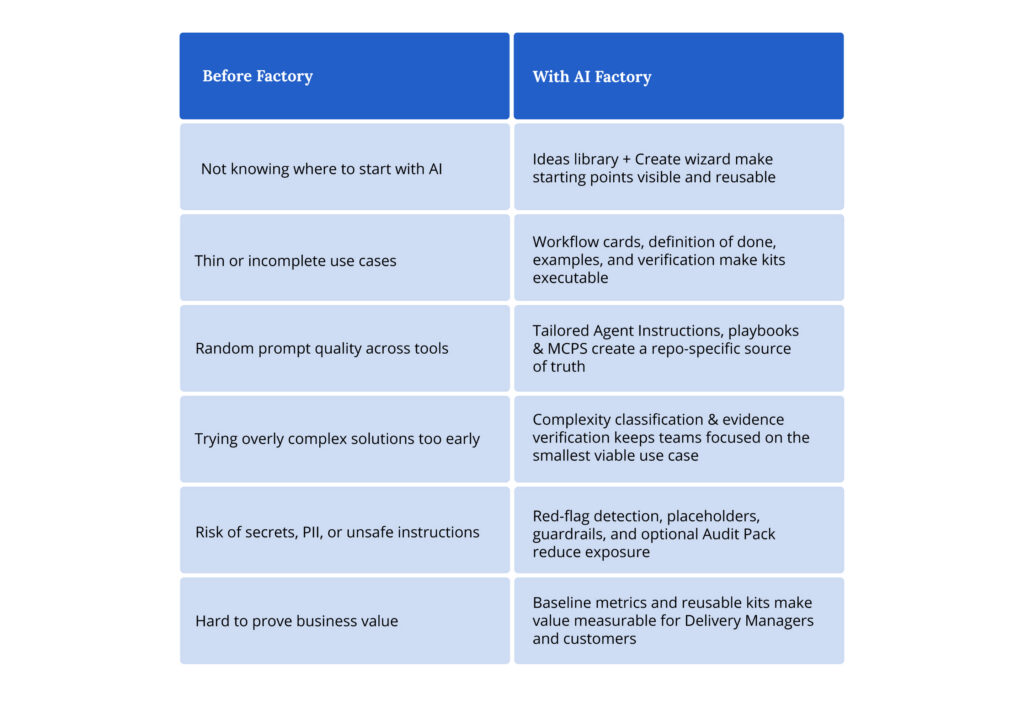
Before AI Factory, the challenge was not lack of interest. The challenge was lack of structure. Engineers often knew AI could help, but they did not always know where to start, how to scope a useful use case, or how to connect an AI-assisted task to the full software development lifecycle.
Removing Enterprise Concerns: The foundation came first
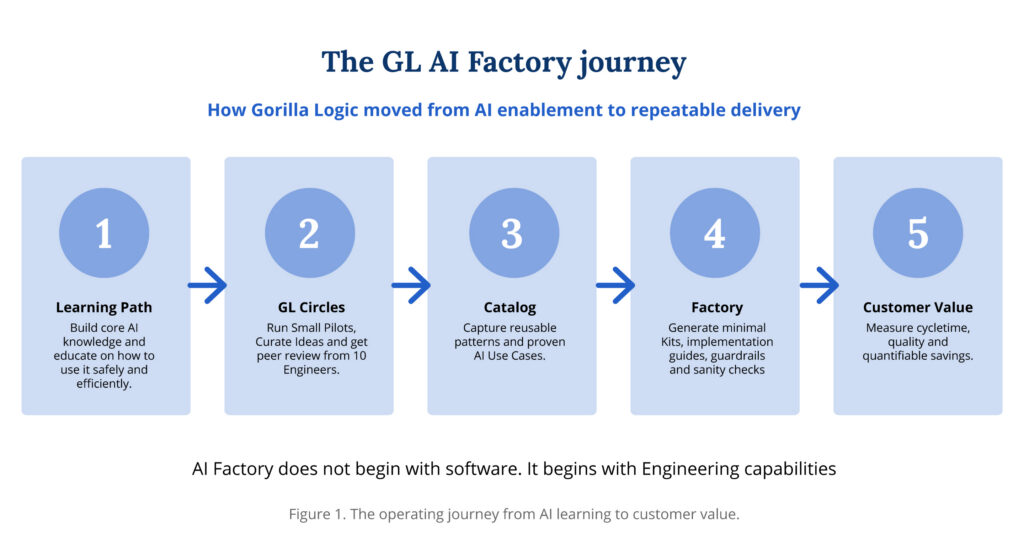
The most important part of this journey is that the Factory does not begin with software. It begins with capability.
Before engineers use the AI Factory, they are expected to complete the Learning Path and acquire the core AI knowledge required to work responsibly & effectively. That matters because AI should not become a shortcut around engineering fundamentals. It should reinforce them.
After the Learning Path, engineers go through the GL AI Circles. This is where the culture changes. Engineers present small pilots, receive structured feedback, and have their implementation reviewed step by step by a roundtable of ten or more peers. That review is not bureaucracy. It is what keeps learning real and grounded.
The third step introduced was the Catalog. It made reusable patterns visible so teams could stop rebuilding the same solutions from scratch. But a catalog is still passive, it helps people find things without operationalizing adoption.
That is where the evolution into AI Factory becomes a game changer. AI Factory adds creation, packaging, import, implementation, and measurement inside a governed AI delivery system.
This is also where important leadership concerns get resolved. AI Factory turns the catalog into a working delivery layer. It is not just a repository of ideas. It is a governed Application that helps engineers build, package, adapt, and execute small AI use cases across multiple tools. Each use case is engineer-created. Each one is intentionally minimal. Each one is kept safe through checkpoints, guardrails, review, and reusable implementation patterns.
Why small use cases are the safer bet
This is a critical design choice. AI Factory is not trying to force every engineer into large, abstract, highly complex AI use cases. It is doing the opposite. It focuses on small AI use cases that can be understood, reviewed, reused, and combined safely. That makes adoption broader, smoother, and far more realistic.
The fear is understandable: powerful AI tools in the hands of underprepared engineers can create weak solutions, poor client outcomes, and false confidence. That risk is real. Gorilla Logic addresses it through sequencing: learn first, pilot small, review publicly, then scale with structured governance.
This sequencing is what makes the AI delivery system durable. The AI use cases remain engineer-created, but the execution becomes minimal and safe through checkpoints, guardrails, and peer-reviewed learning.
Gorilla Logic’s AI delivery system: what AI Factory actually does
We created the AI Factory Application that already ships the intended operating model in product form. Instead of a vague prompt library, it presents a practical workflow that engineers and Delivery Managers can follow end to end.
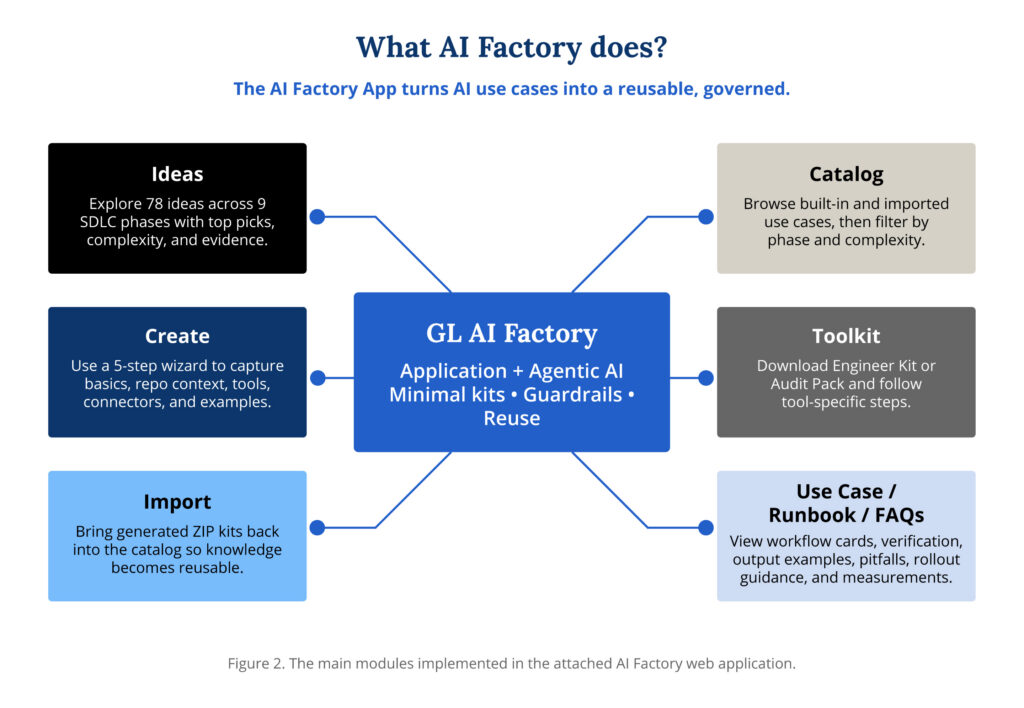
- Ideas: a curated library of 78 AI use cases across SDLC phases, with top picks, complexity, and evidence signals so teams can decide what is worth building next.
- Create: a five-step wizard that captures basics, repo context, tool targets, connectors, and examples, then generates the exact prompt to run in the GL Factory GPT.
- Catalog: a searchable list of built-in and imported use cases, so successful patterns can be compared, filtered, and reused across teams; where it is easy to create a tailored variant.
- Import: the generated ZIP kit can be brought back into the catalog so that knowledge moves from personal experimentation into reusable organizational assets.
- Toolkit and Use Case pages: engineers can preview the files, understand the workflow card, review expected outputs, and follow tool-specific implementation guidance.
- Runbook and FAQs: the application also documents rollout guidance, pitfalls, measurements, and the rationale behind the underlying AI workflow.
This matters because the web app does more than describe AI use cases. It helps turn them into discoverable, governed, and repeatable delivery assets.
How we used Enterprise Agentic AI to keep every kit minimal, current, and safe
We used the most advanced model from OpenAI, Enterprise licensed; the configuration behind the AI Factory is one of the strongest parts of the design. It is not told to generate a giant package by default. It is instructed to generate the smallest repo-ready kit that will actually help an engineer execute the chosen use case.
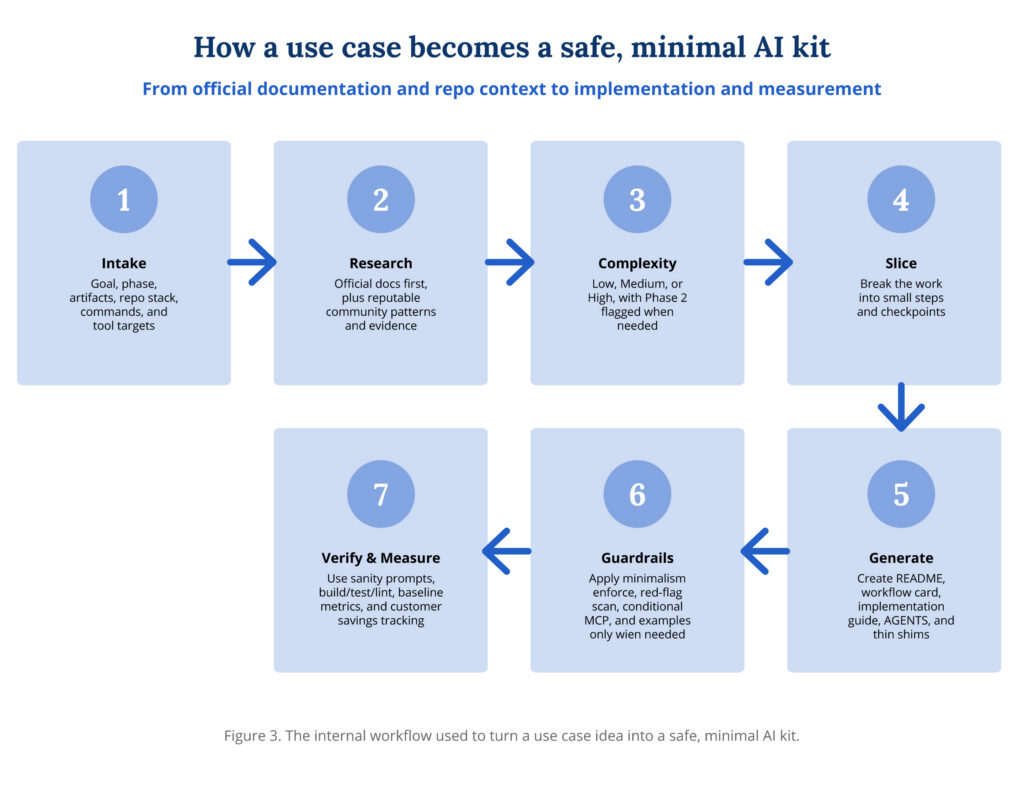
Seven design rules behind every generated kit
- Official documentation first: before a kit is generated, AI Factory is configured to verify current guidance for the selected tools and connectors. The seed knowledge explicitly points to sources such as OpenAI, GitHub, Microsoft / VS Code, Cursor, Anthropic, Atlassian, GitLab, and Figma, and allows reputable community patterns only when they strengthen practical implementation.
- Minimal intake: the GPT asks only for what is missing — use case name, one-sentence goal, SDLC phase, target artifacts, repo stack and directories, commands, tool targets, and security constraints. Missing pieces become FILL_ME placeholders rather than hallucinated details.
- Complexity control: each use case is classified as Low, Medium, or High. High-complexity ideas are not hidden, but they are flagged as Phase 2 so teams can still start with an IDE-first version instead of overbuilding too early.
- Step slicing and checkpoints: the workflow card breaks the work into smaller steps with checkpoints so engineers do not rely on one giant “big bang” prompt. That is one of the clearest ways Factory reduces drift and improves trust.
- Minimal Engineer Kit by default: the GPT always generates README.md, WORKFLOW_CARD.md, IMPLEMENTATION_GUIDE.md, AGENTS.md, and only the thin shims needed for the selected tools. Playbooks, MCP connector setup, and golden examples are conditional, not automatic.
- Guardrails by design: the internal checks include a minimalism enforcer, red-flag detection, removal of secrets or PII, placeholder replacement, and explicit rules such as “do not claim execution” when tests or commands were not actually run.
- Verification remains visible: the implementation guide contains sanity prompts and repo verification commands so the engineer still validates the work in the real repository.
Why does this expands engineers capabilities across the full SDLC
One of the strongest aspects of AI Factory is that it is not just about code generation. As a full AI delivery system, it helps engineers think through the entire software development lifecycle, allowing engineers to amplify their capabilities by softening role boundaries.
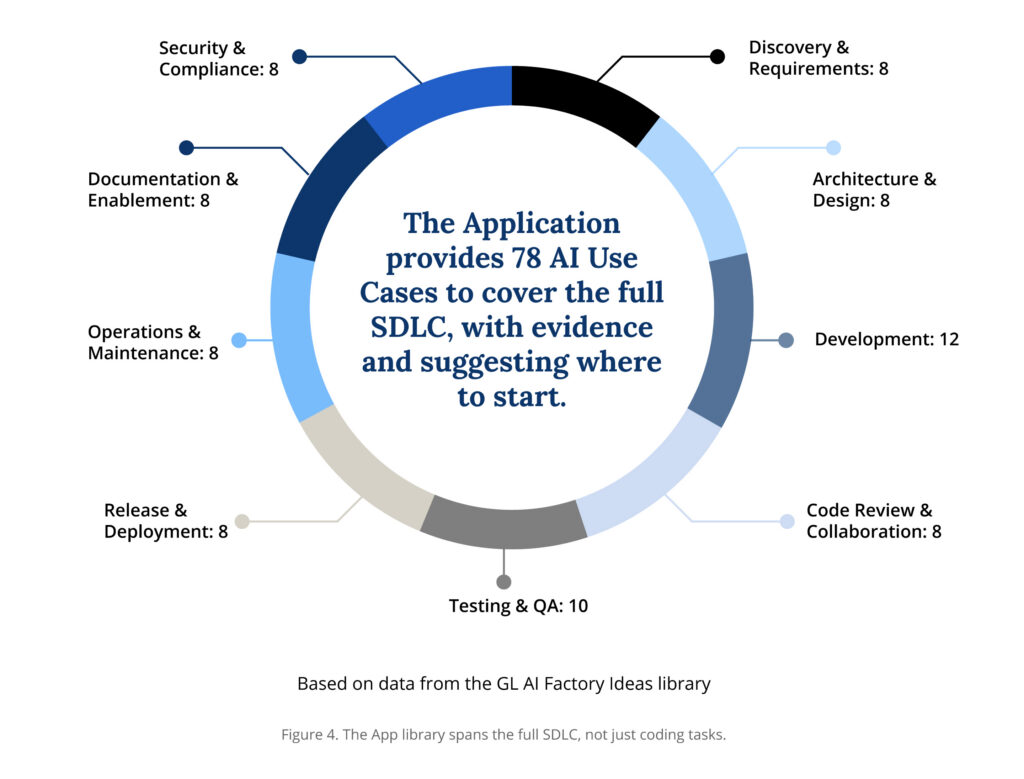
- Requirements and discovery: engineers can work from clearer user stories, stronger acceptance criteria, assumptions logs, and non-functional requirement checklists.
- Architecture and design: Factory supports artifacts such as design document skeletons, ADR drafts, API contract drafts, data model proposals, and threat-model prompts.
- Development and review: it can package workflows for code explanation, refactoring suggestions, PR summaries, reviewer checklists, and missing-test detection.
- Testing, release, and operations: the same model extends into test planning, integration and contract testing, deployment runbooks, feature-flag rollouts, incident triage, and postmortem follow-up.
- Documentation and security: it also supports README refreshes, onboarding guides, architecture documentation, secure coding checks, secrets detection, and PII redaction patterns.
That breadth changes how engineers work with other roles. Architects can engage earlier because design intent, boundaries, and trade-offs are made explicit. Product managers can work from better-framed requirements and acceptance criteria. Designers can connect UX and system decisions earlier in the lifecycle. Engineers become more motivated and more educated because they are no longer using AI only for code generation; they are learning to think across the entire SDLC from requirement to operation.
How does it push engineers to learn more and do more?
By providing a governed structure, the AI Factory functions as a true AI delivery system that encourages engineers to stay up to date and apply best practices, constantly challenging them to deliver with excellence. A few examples:
At the architecture stage, it encourages better solution decomposition. Instead of jumping straight into output, engineers are pushed to think about system boundaries, inputs, dependencies, risk points, and implementation checkpoints.
At the implementation stage, Factory provides minimal viable kits rather than blank pages. Engineers begin with reusable patterns, documented context, recommended workflow steps, and examples of what good output should look like.
At the testing stage, Factory supports more complete delivery by making validation explicit. The use case is not “done” because the AI returned an answer. It is done when the engineer can verify that the output is useful, correct enough for the purpose, and aligned with the intended flow.
This full-lifecycle orientation is important because enterprise AI only creates sustained value when it is connected to real workflows and supported by governance across design, deployment, and ongoing use.
The upgrade from Catalog to Factory
The Catalog solved reuse. AI Factory adds execution, completing the AI delivery system by capturing the use case, generating the minimal kit, importing it back into the organization, guiding implementation in the selected tool, and keeping the workflow measurable.
AI Delivery System: Small to Governance, powerful by educated construction
Another reason this model is powerful is composability.
A Delivery Manager does not need to bet on one giant AI transformation project. Instead, they can work with engineers to choose a small set of valuable AI use cases and combine them into a broader solution over time.
For example, one team might start with:
a requirements expansion use case,
a design or diagramming support use case,
and a testing or evidence-generation use case.
Each one is small. Each one is reviewable. Each one is measurable. Together, they form a stronger end-to-end solution.
That is how the AI Factory creates scale without chaos. Complexity is not ignored, but it is introduced deliberately through composition, not through a giant leap at the beginning.
How Delivery Managers turn small use cases into measurable customer value
Delivery Managers are essential in this model. They do not receive a black-box tool and hope teams figure it out. They select the AI use cases together with engineers, choose the right order, and decide when several small use cases should be composed into a more complete customer solution.
- Start with a small use case such as story clarification, code behavior explanation, PR summary generation, or test plan drafting.
- Validate it in one repository with one team and one clear outcome.
- Import the kit into the catalog so other engineers can reuse it.
- Compose several small use cases together only when the workflow is proven — for example, story clarification + acceptance criteria + test plan + PR summary can become a lightweight delivery accelerator.
- Measure the gains before scaling: cycle time, review rounds, time-to-test-plan, rework hours, defect reduction, onboarding/debug time, and adoption.
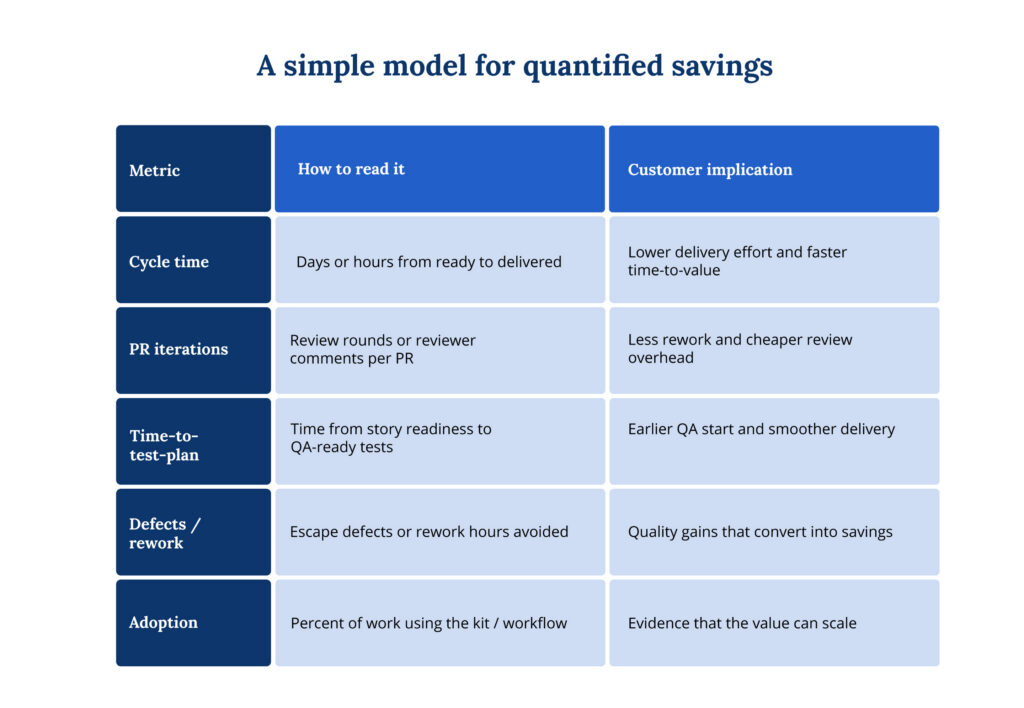
Savings formula
Customer savings = (hours saved per execution × execution frequency × blended delivery rate) + rework avoided + defect or incident reduction value – enablement cost. Factory gives Delivery Managers a way to measure these gains instead of describing AI value only in qualitative terms.
AI Delivery System: The success story now within reach
The first visible success story for AI Factory will not be a giant complex AI Use Case. It will be a team that chooses a few small use cases, runs them through the Learning Path and GL Circles, turns them into reusable kits through AI Factory, and then shows a customer that the work moved faster with less ambiguity, less rework, and better traceability from requirement to operation.
That is what makes the AI Factory a game changer. It converts learning into delivery. It converts individual experiments into reusable organizational assets. It widens AI beyond coding into the full SDLC, expanding engineering capabilities. And it gives leaders a way to balance speed, safety, and measurable customer value in the same operating model.
In other words, AI Factory is not just a better prompt library. It is the beginning of a practical AI delivery system for engineering.
That direction also matches what broader enterprise AI research is showing: the organizations seeing stronger AI value are redesigning workflows, retraining people, and elevating governance, while trustworthy deployment guidance increasingly emphasizes risk management across design, deployment, and use. AI Factory is compelling because it operationalizes those principles inside everyday engineering work.