


As AI adoption accelerates, a quiet consolidation is happening underneath it. Organizations are being pulled toward single vendors, bundled ecosystems, closed orchestration layers, and proprietary agent frameworks, the ingredients of AI platform lock-in. The vendors making these offers are betting on stickiness. The question is whether that bet aligns with your interests as well as theirs.
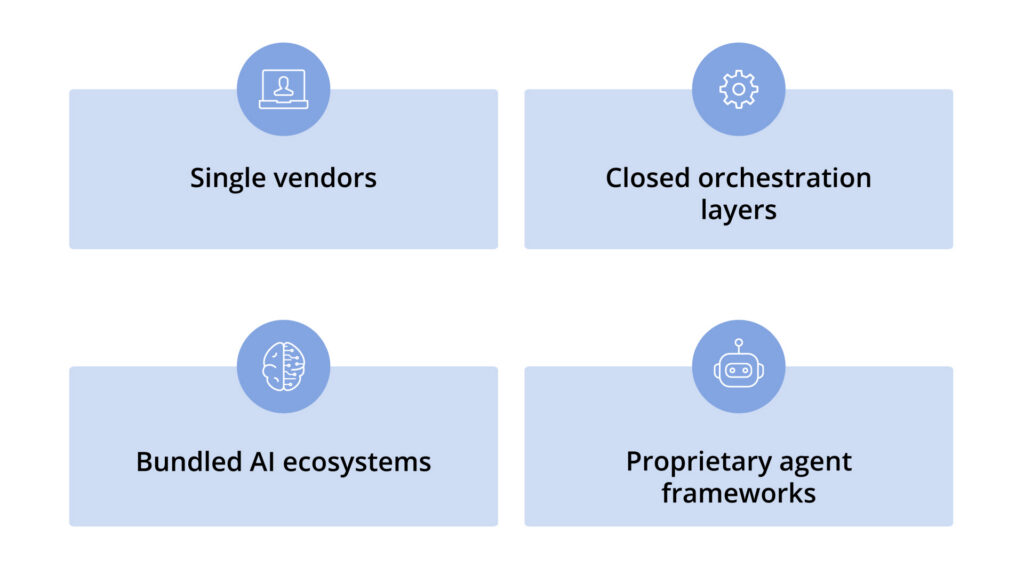
The pitch is compelling: one throat to choke, one roadmap to follow, one bill to pay. The simplicity is real. But so is a risk that doesn’t show up in most AI strategy conversations: the more successfully your organization adopts AI, the harder it becomes to change course.
Consider what deep AI adoption actually looks like. AI embedded in incident management. AI coordinating deployment pipelines. AI woven into QA cycles, documentation workflows, modernization programs. The deeper it goes, and the more it goes into the orchestration layer we discussed in Part 2 , the more your operating model becomes an expression of the platform you chose. And in a technology landscape moving as fast as AI is right now, that’s a significant strategic exposure.
This is the lock-in problem. And it’s quietly becoming a boardroom conversation.
The AI Landscape Is Evolving Too Fast for Lock-In
In traditional enterprise software, platform commitments made sense. The technology was mature, switching costs were predictable, and the competitive landscape moved slowly enough that a multi-year vendor relationship was a reasonable trade. You gave up optionality in exchange for depth, support, and integration.
AI doesn’t operate on that timeline. New models are released continuously. Performance benchmarks that defined best-in-class six months ago are already being surpassed. Compute costs fluctuate. Open-source alternatives are closing the gap with commercial offerings faster than most enterprise procurement teams can track. What you’re committing to today is a snapshot of a landscape that will look materially different by the time your contract is up for renewal.
Locking into a single vendor’s ecosystem in this environment isn’t just a technical decision. It’s a bet that the platform you chose today will still be the right one in two or three years.
The Hidden Cost of Platform Dependency
Platform dependency creates friction in two distinct ways, and understanding both matters.
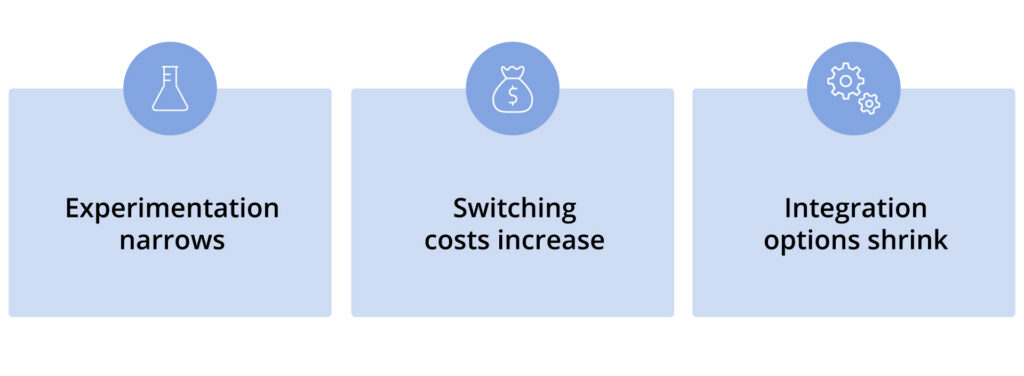
The first is around innovation. When engineering teams are tied to a single ecosystem, experimentation naturally narrows you explore what the platform supports rather than what’s possible. Switching costs increase with every workflow you build on proprietary tooling. Integration options shrink as your architecture becomes an expression of one vendor’s decisions rather than your own.
The second is economic, and it’s more volatile than most organizations anticipate. AI compute costs shift. Model pricing changes, sometimes dramatically, as the competitive landscape evolves.
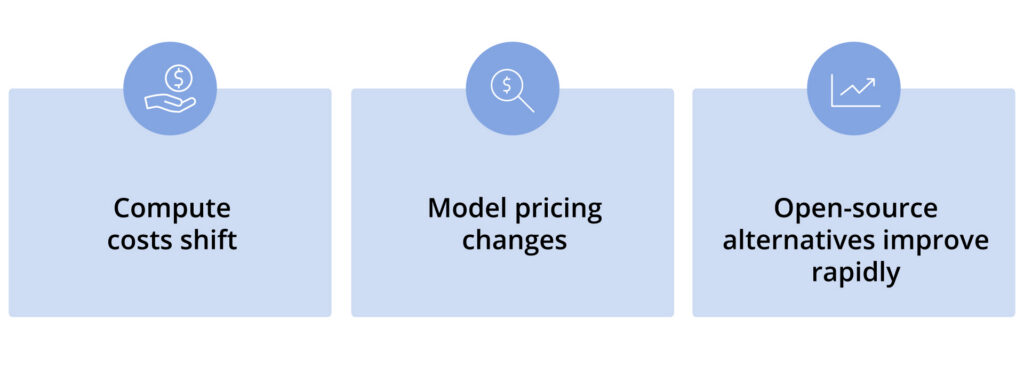
Open-source alternatives are improving rapidly and closing the gap with commercial offerings faster than most procurement teams can track. Optionality preserves negotiating leverage. Lock-in reduces it, at precisely the moment the market is moving in ways that would otherwise work in your favor.
But the deeper problem sits underneath both of these. When AI is handling task-level work (code suggestions, PR reviews, test drafts) migration is annoying but manageable. When AI is embedded in the connective tissue of your engineering organization, migration means redesigning processes that entire teams have built their work around. The disruption isn’t just technical. It’s organizational.
The organizations most exposed to this risk are the ones that have done AI adoption well. They’ve moved through the layers. Their processes are more efficient precisely because AI is deeply integrated into them. Unwinding that integration becomes expensive in direct proportion to how successful the adoption was in the first place.
Why Frameworks Outlast Platforms
The distinction that forward-looking engineering leaders are drawing is between building on a platform and building a capability.
A platform is a product someone else controls. Its roadmap, its pricing, its architectural decisions, none of that is yours. When it changes, you absorb the consequences.
A framework is a methodology your organization owns. It describes how work flows, how AI integrates into that flow, and what outcomes you’re measuring, independently of which specific tools are executing the work at any given moment.
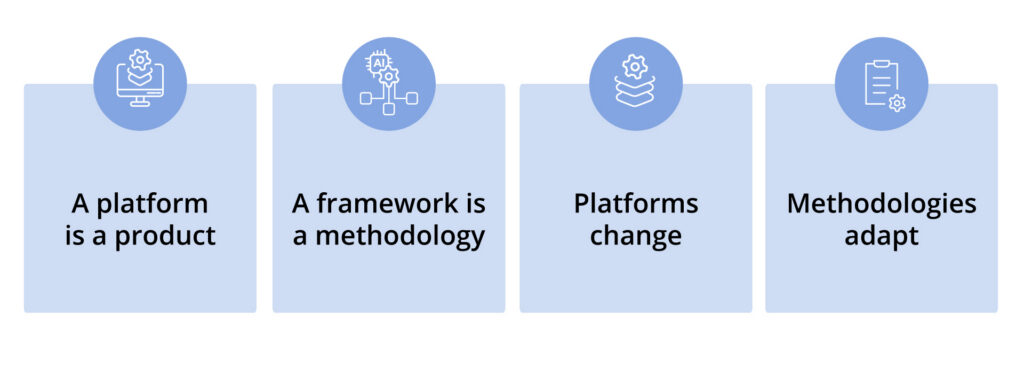
Organizations that build this way can swap models, integrate new tools, and adopt emerging agent technologies without rewriting their operating model. The AI landscape changes underneath them, but the capability they’ve built remains intact.
This isn’t an argument against platforms. It’s an argument for building in a way that doesn’t require allegiance to any single one.
The Question Worth Asking Before Your Next Platform Decision
The framing most organizations use when evaluating AI platforms is some version of: “Which vendor gives us the best capabilities today?” That’s not the wrong question, but it’s incomplete.
The more durable question is: “How do we design workflows that remain adaptable as AI evolves?” It shifts the evaluation from features to architecture, from what the platform can do now to what your organization will be able to do regardless of what the platform does next.
The organizations that will have the most strategic flexibility in 2026 and beyond aren’t necessarily the ones that chose the best platform. They’re the ones that built the most adaptable operating model, one where the platform is a component, not the foundation.
That’s a harder thing to build. It requires defining workflow architecture before selecting tools, separating orchestration logic from model dependency, and maintaining governance structures that support ongoing experimentation rather than locking in early decisions. But the organizations treating AI as foundational infrastructure, which is what it’s becoming, are the ones who understand that infrastructure decisions compound. A rushed platform commitment today can become a multi-year constraint tomorrow.
Closing the Series
Across these three pieces, the through-line has been the same: AI productivity gains don’t come from tools. They come from how deliberately you operationalize AI across your organization, at the task level, the workflow level, and the orchestration level, and how thoughtfully you build the capability to keep evolving as the technology does.
Copilots are the starting point. Workflow redesign is where velocity becomes measurable. Orchestration is where the largest gains emerge. And optionality, the ability to adapt without starting over, is what makes those gains durable.
The competitive advantage in this next cycle won’t belong to the organizations that adopted AI earliest, or that committed most deeply to a single platform. It will belong to the ones that built the most adaptable foundation. That’s a less exciting pitch than the 50–80% productivity headlines. But it’s the one that holds up.
This article is based on a recent conversation between Drew Naukam, our CEO, and Bob Graham, our Chief Growth Officer. You can watch the full discussion here.