


Across engineering organizations, a familiar paradox is playing out: developers feel more productive than ever, yet delivery timelines and quality remain largely unchanged. AI tools are in use, velocity appears to be up, and somehow outcomes aren’t improving.
The reason is straightforward, even if uncomfortable. If requirements are unclear, architectural decisions are rushed, testing remains manual, or deployments are risky, then accelerating code creation simply pushes work faster into existing bottlenecks. The system doesn’t improve; it just produces output more quickly into the same constraints.
What’s driving this is a pattern we see repeatedly: AI capabilities get acquired in response to competitive pressure before the underlying delivery system has been assessed or stabilized. Pilots launch without success criteria or designated owners, initial velocity spikes give leadership confidence, and the structural ceiling stays exactly where it was. The real bottleneck was never typing speed. It lives in planning ambiguity, handoff friction, and review cycles.
AI Is a Force Multiplier — For Better or Worse
Before asking “how do we go faster with AI?”, there is a more important question to answer: what system are we accelerating?
AI is a force multiplier. It amplifies whatever system it enters. That equation works in both directions.
If the system is unstable (misaligned priorities, weak governance, constrained flow), AI will amplify that instability. Misaligned priorities lead to faster production of misaligned outputs. Weak standards scale inconsistency more quickly than human processes can correct. Bottlenecks in handoffs or approval cycles do not disappear; instead, increased development speed compresses downstream stages even further.
If the system is disciplined (clear standards, enforced processes, and measurable delivery), AI accelerates value.
This means that before any organization authorizes AI investment, three questions need honest answers:
- What systems are we accelerating?
- What is our definition of success?
- What is our main goal and priority?
These questions aren’t philosophical. They’re diagnostic. And skipping them is the reason most AI initiatives produce activity without outcomes.
What AI-Enabled Engineering Actually Means
AI-Enabled Engineering is not about adopting a specific product or feature. It is about systematically embedding AI across the entire engineering lifecycle to improve how decisions are made, how work flows, and how value is delivered.
Seen this way, AI-Enabled Engineering is about:
- Augmenting human judgment based on expertise, not replacing it
- Reducing friction across workflows, not just accelerating isolated tasks
- Improving delivery outcomes, not just developer productivity metrics
IDE copilots are a legitimate starting point. But they are an on-ramp, not a destination. Teams that stop there will find themselves writing code faster into the same slow, uncertain, fragile delivery systems they have always had.
What We Consistently Find Across Organizations
When organizations begin AI-enabled engineering engagements, a consistent set of gaps emerges not in tooling, but in the foundations that tooling depends on.
Product Foundation Gaps
- Portfolio trade-off logic is inconsistent across Core, Expansion, and Discovery bets. Investment categories exist on paper; the discipline to allocate and validate against them does not.
- Expansion bets lack systematic validation. Assumptions are carried forward without evidence, and there is no cadence for testing whether bets are paying off.
- Metrics exist in isolation rather than as inputs to trade-off conversations within and across teams.
- Metric definitions are not shared and decision cadence is undefined.
- There is no system to surface or track bottlenecks. Delivery friction is felt but not instrumented, making root causes invisible and recurring.
SDLC Foundation Gaps
- Portfolio tradeoff inconsistency: Core vs Expansion vs Discovery
- Agile ceremonies exist, but discipline is uneven across teams. The rituals are present; the maturity is not.
- Definition of Ready and Definition of Done are weak or undocumented. Story readiness is assumed, not enforced; done criteria are ambiguous.
- Coding and architecture standards are inconsistent, with no shared guardrails and divergent quality patterns across teams.
- Baseline delivery metrics — throughput, velocity, cycle time, defect density — are unmeasured at engagement start.
AI Adoption Gaps
- Acceleration is requested without strategy. Leadership demands AI speed with no constraint diagnosis preceding it.
- AI usage is inconsistent across teams and individuals. There are no shared practices, security controls, governance or tooling guidelines, making adoption patchy and its impact uneven.
- There are no success criteria or ownership models. No one is accountable for outcomes; no definition of what “better” looks like has been established.
- There is no measurement framework, making it impossible to distinguish AI contribution from natural team variance.
- There is no knowledge transfer plan. AI usage is concentrated in individuals rather than built into institutional capability.
These gaps don’t disappear when you introduce AI. They get amplified. The only path to sustainable ROI is fixing the system before inserting the accelerant.
A Disciplined Lifecycle: Stabilize Before You Accelerate
AI acceleration requires a disciplined sequence. The same pattern applies across every environment — what changes are the specific constraints at each step, not the structure of the loop itself.
1. Diagnose Map the delivery system. Identify constraint categories: planning friction, handoff delays, QA bottlenecks, governance gaps, missing metrics. Do not proceed until the actual constraints are named.
2. Baseline Establish quantitative starting points — velocity, throughput, PR cycle time, defect density, test coverage, sprint predictability. You cannot measure improvement against an unknown starting state.
3. Stabilize Strengthen Definition of Ready and Definition of Done, enforce coding standards, establish PR review guidelines, and align QA cadence with development. This step must precede any AI introduction. Without it, AI scales the dysfunction.
4. Insert AI into the Flow Embed AI at the constraint points identified in the diagnosis, not everywhere at once. The appropriate level depends on the maturity of the system: task augmentation, workflow automation, or orchestration of end-to-end processes.
5. Measure Validate interventions against baselines. Surface improvements in flow, quality, and predictability. Attribute changes to specific interventions. AI contribution should be distinguishable from natural team variance.
6. Iterate Refine AI placement based on measured outcomes. Remove the next constraint. Expand where removal is confirmed. Scale what is working; stop what is not.
The loop does not change. The inputs do.
AI Across the Engineering Lifecycle
When organizations think about AI as a system-level intervention rather than an individual productivity tool, new opportunities emerge at every stage of delivery.
Data and Systems Landscape Before any AI tool can deliver value, teams must understand the systems, data sources, and integration points that define their environment. Without this foundation, AI initiatives stall or fail, a pattern that serious engineering organizations have learned the hard way. This means auditing existing data quality, mapping how systems communicate, and identifying where AI can realistically be applied given your constraints. Context, memory and relations must be prepared for specific goals.
Discovery and Planning AI can synthesize stakeholder inputs, clarify requirements, and translate business goals into actionable user stories, reducing the rework that comes from misaligned expectations. Key signals to watch: the percentage of work items requiring re-clarification and the time from idea to “ready to build.”
Design and Architecture AI can support architectural exploration by evaluating options, surfacing trade-offs, and identifying risks early. Rather than replacing architects, it acts as a second set of eyes, helping teams reason through complex systems more effectively. Key signal: the rate of late design changes after development has begun.
Development This is where IDE copilots shine, but they are not alone. AI can assist with refactoring, test generation, static analysis, PR reviews, and documentation, helping teams move faster without sacrificing consistency or maintainability. Key signal: the ratio of waiting time to working time across the board.
Testing and Quality AI can help generate test cases, identify edge conditions, and assess regression risk, shifting quality from a late-stage gate to a continuous practice embedded in delivery. Key signal: failed release rate and defect escape rate.
Delivery and Operations Beyond release, AI can support incident analysis, summarize logs and metrics, automate runbooks, and synthesize post-mortems. Teams learn faster, respond more effectively, and continuously improve system reliability. Key signal: time to recover from production incidents.
Governance: A Prerequisite, Not an Afterthought
AI adoption is a governance decision, not a technology purchase. Without governance, tools proliferate without purpose, and accountability evaporates.
Effective AI governance operates across four dimensions:
Ownership. AI must have a senior leader accountable for delivery impact, not adoption metrics. Someone must own the outcomes, not just the rollout.
Prioritization. AI initiatives must be prioritized against diagnosed constraints and expected value. If an initiative is not tied to a specific constraint, it has no measurable impact and should not be funded.
Tool Governance. Each tool must serve a defined purpose in the delivery system. No duplication. No overlap. No experimentation without intent. Tools support the model, they do not define it.
Measurement and Reporting. Impact is tracked against system health: flow, predictability, and risk reduction. Not usage counts. Not activity metrics. The goal is structural delivery improvement, not proof of engagement.
Why the Operating Model Matters More Than the Tools
One of the most common reasons AI initiatives underperform is that they’re layered onto unchanged operating models. Research from Boston Consulting Group (BCG, Companies Must Go Beyond AI Adoption to Realize Its Full Potential, June 26, 2025) shows that companies that go beyond simply deploying AI tools and instead redesign how work gets done, including training, workflow integration, and change management, capture significantly more value from AI than those that focus on tool adoption alone, in other words, are more likely to generate measurable business impact, including improved decision making, time savings, and strategic outcomes.
Teams that embed AI into shared workflows consistently outperform teams where AI usage is left to individual preference. The difference isn’t which tools are installed. It’s how work is organized, prioritized, governed, and learned.
In mature AI-enabled engineering organizations, you see a consistent pattern: engineers spend less time searching, waiting, and reworking; product and delivery leaders have clearer visibility into flow and risk; decisions are increasingly data-informed; and AI accelerates learning, not just execution.
This is where AI-Enabled Engineering becomes a strategic capability rather than a productivity experiment.
Introducing Gorilla Logic Construct™
At Gorilla Logic, this philosophy isn’t theoretical, it’s what we do every day for our clients. We’ve codified it into Gorilla Logic Construct™, our proprietary framework and reusable asset library designed to embed AI directly into how teams build and deliver software.
Construct™ operationalizes AI across three progressive levels, each building on the last:
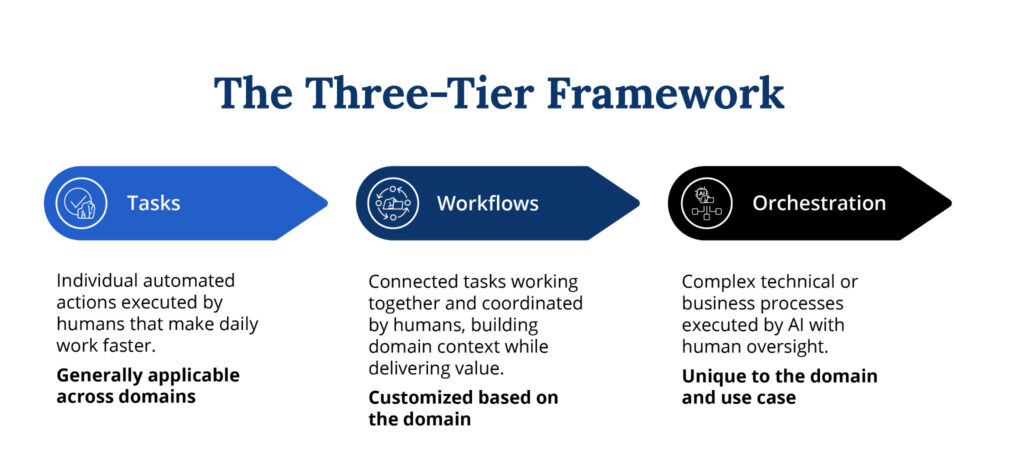
Level 1: Tasks
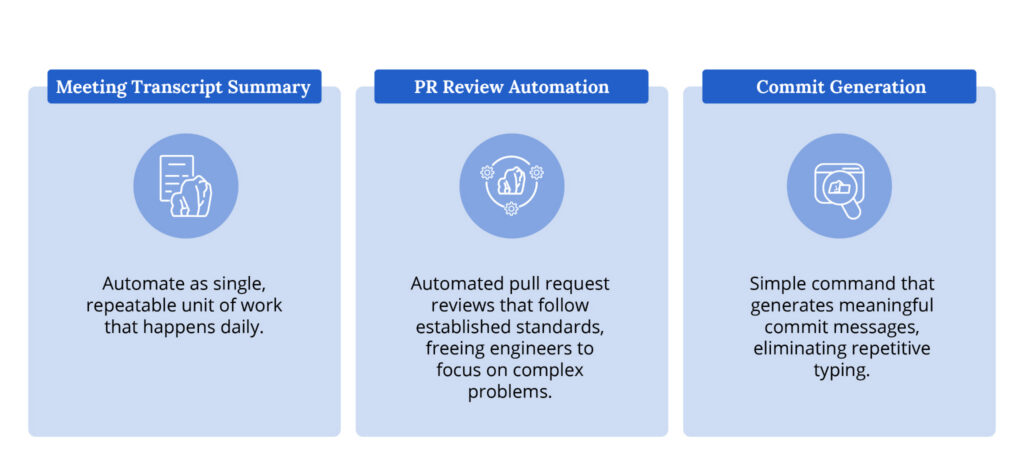
Individual automated actions that make daily work faster. These are domain-agnostic and immediately applicable: things like automated PR reviews, commit message generation, and meeting transcript summaries. They’re the foundation: quick wins that build confidence and momentum.
Level 2: Workflows
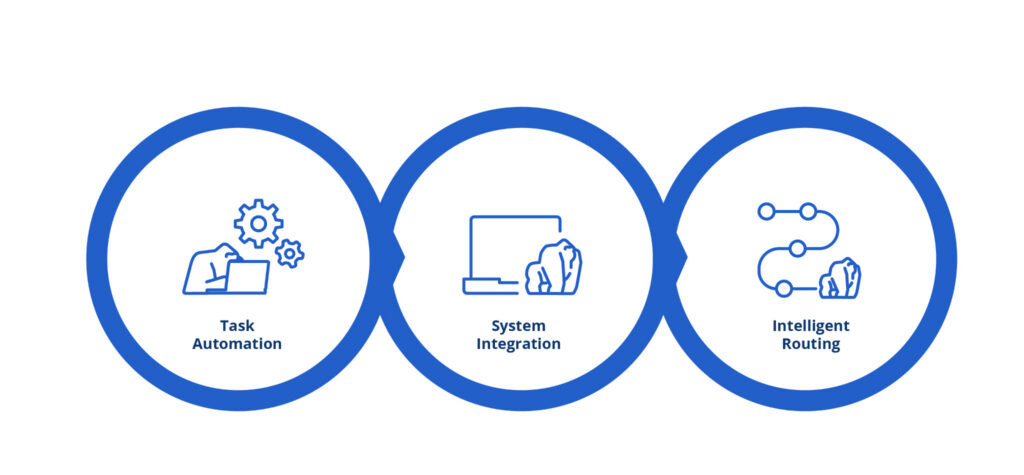
Connected tasks working together, coordinated by humans, that span systems and build institutional knowledge. A good example is our System Documentation Workflow, which chains code analysis, documentation generation, verification, and formatting to produce comprehensive technical documentation for legacy codebases in hours rather than weeks.
Level 3: Orchestration
The most sophisticated tier: complex technical or business processes executed by AI agents with human oversight. At this level, agents handle entire processes end-to-end — monitoring, validating, testing, and deploying autonomously. Orchestration is unique to each domain and requires deep discovery; a generic approach simply won’t work in complex client environments.
The Construct™ Collection brings this framework to life through a library of reusable assets: tested prompt patterns, pre-built agents, standardized templates, reference architectures, and structured workshops — all ready for deployment across engagements.
What This Looks Like in Practice
The results from real client engagements illustrate what’s possible when AI is embedded across the delivery lifecycle rather than confined to the IDE.
At a life sciences technology company, applying Construct™ across planning, engineering, and QA reduced development cycle time by 40–50% through AI-assisted coding and PR reviews, cut test case creation effort by 35–45%, and reduced duplicate bug reports by roughly 40%.
At a healthcare data and diagnostics firm, a structured AI experimentation program (combining leadership enablement, AI-assisted PR reviews, and an AI-powered unit test generator) produced a 50% reduction in bug resolution time and unit test creation that was approximately 60% faster, with coverage exceeding 80%.
These aren’t the outcomes of faster typing. They’re the outcomes of a more effective delivery system.
What Actually Creates Advantage
Most organizations measure the wrong things. Lines of code, commits per developer, AI tool utilization rates, percentage of tests AI-generated, seats activated — these metrics indicate activity. They do not indicate competitive advantage.
The metrics that matter are structural:
- Reduced rework: Fewer defects escaping to production. First-pass quality improving over time.
- Predictable delivery: Reduced sprint volatility. Commitments that hold at scale.
- Shorter idea-to-value cycles: Compressed cycle time from business decision to production deployment.
- Lower delivery volatility: Stable, compounding velocity replacing unpredictable throughput.
The real signal is Return on Acceleration measured by structural delivery improvement, not tool activity. Productivity spikes without structural change are temporary. Sustainable ROI requires constraint diagnosis, and measurement and ownership must precede deployment.
The Right Sequence
Every organization is asking “how do we go faster with AI?” It is the wrong question to ask first.
The right sequence is:
- What are our delivery system constraints?
- Have we baselined and stabilized the foundation?
- Where does AI remove friction at a specific node?
- What is the right AI solution for this context — keep Harness Engineering in mind and keep complexity as low as possible
- How will we measure the shift, and what does success look like?
The organizations that will get the most from AI in engineering will be those who enable AI: those who build the system conditions that let it actually work. That means treating AI as an organizational capability, one that improves how decisions get made, reduces the friction that silently kills delivery, and tightens the feedback loops that let teams continuously improve.
This shift does not happen by installing tools. It happens by redesigning how work flows, embedding AI into shared rituals and decision points, and measuring what actually matters: delivery effectiveness, not just developer output.
The question for engineering leaders is not “are we using AI?” It is “is our system of delivery getting meaningfully better?” If the answer is anything other than a clear yes, the opportunity — and the work — is still ahead.