


The traditional private equity value creation model was built on a clear sequence: acquire a business with strong fundamentals, improve the margins, expand the multiple, exit. It was disciplined, repeatable, and, for a long time, reliably sufficient. The firms that executed it well didn’t need to reinvent anything. They needed to be better operators than the previous owners.
That model hasn’t stopped working. But it’s no longer enough on its own, and the firms that are still running it as their primary playbook are finding the math increasingly difficult.
How Private Equity Value Creation Moved Beyond Optimization
The shift is easier to understand when you look at what’s changed on the competitive landscape rather than inside the PE model itself. A decade ago, an incumbent business with a solid customer base and predictable revenue had meaningful structural protection. Competitors took time to build. Market entry required capital, distribution relationships, and product development cycles measured in years. A well-run company could afford to move deliberately.
That protection has eroded. The time it takes a well-funded startup to enter a market, build a product, acquire early customers, and begin threatening established players has compressed dramatically. They often do it with smaller teams, lower cost structures, and architectures that were designed from the start for speed and iteration. The competitive advantage no longer belongs to the company that optimizes most efficiently. It belongs to the one that can change the fastest.
That’s a fundamentally different problem than the one PE has historically been built to solve. Efficiency still matters. But the firms outperforming in this environment are the ones learning to pursue something harder: increasing the rate at which a portfolio company can adapt and evolve.
The Execution Gap Undermining Private Equity Value Creation
Scott Darby, a Gorilla Logic board member with extensive experience advising private equity firms on technology strategy, and Drew Naukman, Gorilla Logic’s CEO, recently sat down to talk through what’s actually driving (and stalling) value creation in PE-backed companies today. The insights in this article come from that conversation.
One of the patterns Scott returns to repeatedly is the moment after an acquisition closes. The investment thesis is articulated clearly: the technology platform will be modernized, development velocity will increase, AI will be leveraged to accelerate delivery. The leadership team is aligned on the destination. The engineers understand the expectation. And then the actual work begins, and the distance between where the organization is and where it needs to be becomes visible in a way that slides and models don’t capture.
The engineering team is capable, but the architecture they’re working against was built for a different era and a different scale. The product organization has priorities that shift frequently. The AI tools that were supposed to unlock velocity require workflow changes nobody has designed yet. And everyone is simultaneously trying to meet current delivery commitments while executing a transformation on top of them.
Scott describes it as a consistent pattern across the firms and portfolios he works with: teams are being asked to move dramatically faster without a clear path to get there. The goal is set. The mechanism is unclear. And the gap between the two is where value creation either happens or doesn’t.
This is what makes the execution gap the most important (and least discussed) challenge in modern private equity value creation: the strategy is usually sound, and the organizational reality that has to deliver it is genuinely difficult to move at the speed the strategy requires.
Evolving the Operating Model for a New Kind of Growth
Historically, when companies needed to improve performance, the path was relatively clear: expand teams, optimize cost structures, and refine operating processes.
Those approaches still have a place. They remain effective in stable environments and for businesses where the pace of change is more predictable.
What has changed is the context.
Today, many organizations are being asked to deliver significantly higher levels of velocity—sometimes multiples beyond what their current operating model was designed to support. That kind of acceleration cannot be achieved through incremental adjustments alone.
Expanding teams, for example, does not automatically translate into faster delivery. In fact, without the right systems and processes in place, it can introduce additional complexity.
Similarly, transformation efforts driven entirely from within the organization often face a different constraint: time. Most teams are balancing day-to-day delivery with long-term change, which makes it difficult to redesign how work gets done while continuing to meet immediate expectations.
This is why leading organizations are reframing the challenge.
Instead of asking how to optimize what exists, they are asking how to evolve the operating model, bringing together talent, technology, and ways of working that are designed for speed, adaptability, and sustained growth.
From Efficiency to Acceleration: The Evolution of Value Creation
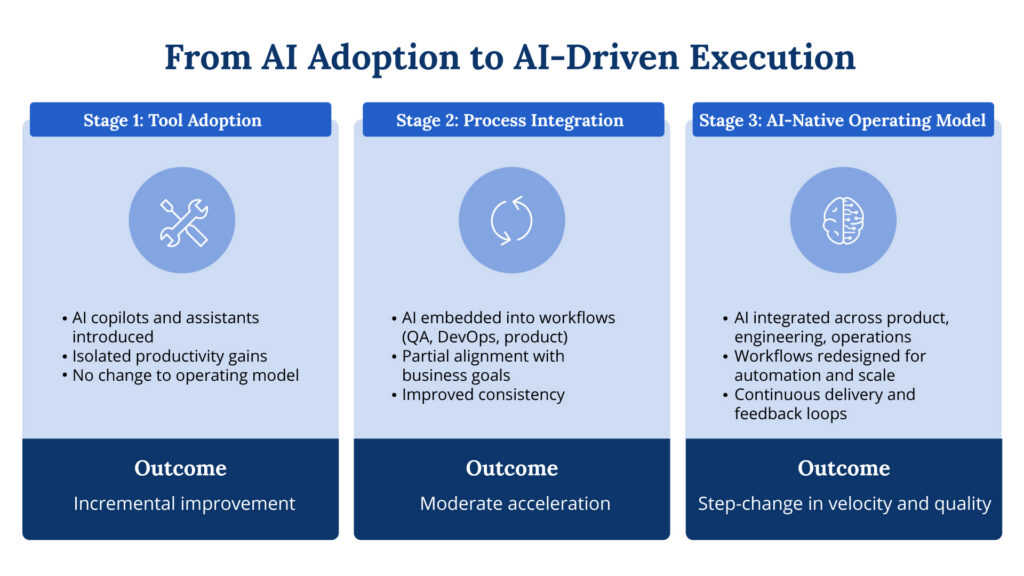
Private equity value creation is shifting from efficiency-driven optimization to technology-enabled acceleration. Organizations that successfully evolve their operating model are able to deliver sustained growth and increased valuation.
The Modern Private Equity Value Creation Model: Internal Leadership Meets External Expertise
What is emerging instead is a different model: one that blends internal leadership with external expertise in a much more intentional way.
Not as augmentation. As acceleration.
The role of external partners is evolving from “additional capacity” to capability enablement.
The best partnerships are not just about delivering work. They are about transferring knowledge, introducing proven patterns, and helping organizations operate at a level they could not reach on their own within the required timeframe.
This is particularly critical in areas like AI-enabled engineering, platform modernization, and product acceleration, where the pace of change is too fast for most organizations to navigate independently.
And when done correctly, the impact is not temporary.
It reshapes how the organization operates.
What High-Performing Portfolio Companies Do Differently
The companies generating the strongest technology-driven returns from their PE partnerships tend to share a few characteristics that are worth naming precisely because they run counter to common instincts.
They start with outcomes, not tools. Before any AI initiative or modernization program gets approved, they ask: how fast do we need to move to win in this market, where are we specifically constrained today, and what needs to be different in the next 18 months to unlock the growth we’re underwriting? The answers to those questions determine the technology strategy, not the other way around.
They treat modernization as a growth initiative rather than a cleanup effort. The framing matters because it determines where it sits in the priority stack. Infrastructure work that’s categorized as technical housekeeping gets deprioritized under delivery pressure. Infrastructure work that’s directly connected to a revenue outcome or an exit multiple gets protected.
And they measure relentlessly at the operational level. Not developer satisfaction. Not AI adoption rates. Cycle time, deployment frequency, defect rates, time from idea to customer. The metrics that demonstrate whether the operating model is actually changing, and that tells a credible story to buyers at exit.
The Role of AI: Amplifier, Not Shortcut
AI deserves its own treatment here, because the expectations around it in private equity are simultaneously inflated and underspecified. Inflated in the sense that some theses treat AI as a mechanism for step-change productivity gains that can be underwritten before any organizational groundwork has been laid. Underspecified in the sense that “AI adoption” as a strategic objective doesn’t describe anything actionable.
The organizations getting genuine leverage from AI are treating it as an amplifier of an operating model that already has the fundamentals in place: strong product leadership, disciplined prioritization, clean enough architecture to move quickly, and engineering practices that can absorb and apply AI tooling effectively. In those conditions, AI can meaningfully compress cycle times and improve output quality. Without those conditions, it tends to reveal and amplify whatever dysfunction already exists.
The practical implication is that AI strategy and operating model design aren’t separate workstreams. You can’t run an AI adoption program in parallel with an unreformed delivery process and expect the gains to compound. The two have to evolve together.
A Narrow Window: Why Timing Defines Private Equity Value Creation
Private equity’s defining constraint is time. Most firms operate within a three-to-five-year hold period, and the window where meaningful change can be established, and demonstrated, is much shorter. Decisions about technology, operating model, and talent made in the first 12 to 24 months determine the trajectory of the business far more than decisions made later. By the time a company enters the exit process, the story is already largely written.
Buyers aren’t just evaluating historical financial performance. They’re evaluating trajectory, the credibility of the business’s ability to continue growing, adapting, and competing in a market that isn’t standing still. And increasingly, the evidence they’re looking for is grounded in the strength of the technology foundation and the demonstrated capability of the team running it.
The firms that will outperform in this environment are the ones that translate strategy into execution early. Not because the traditional disciplines of PE don’t matter anymore (they do) but because those disciplines now operate on a faster clock, in a more competitive market, where technology is the primary mechanism of differentiation.
The organizations that recognize this early, and build their operating model around it, are the ones setting the terms of the next generation of private equity value creation.
Scott and Drew cover a lot more ground in the full conversation, from the specific decisions that separate high-performing portfolio companies to where most firms are still leaving value on the table. Watch the full conversation here.