
A CTO at a Fortune 500 manufacturer approves a three-year modernization roadmap. Six months later, the legacy ERP that processes 2.4 million daily transactions hits a critical performance threshold. The modernization team needs 18 more months. Operations cannot wait that long.
This scenario plays out across enterprises every quarter. The gap between modernization timelines and day-to-day operational stability creates real business risk. Legacy system support before full modernization is a strategic discipline that protects revenue, maintains compliance, and preserves the institutional knowledge encoded in aging codebases. Gorilla Logic helps enterprise technology leaders navigate exactly this challenge through AI-enabled engineering that accelerates both stabilization and eventual modernization.
This article outlines the leading legacy system support options available for keeping aging applications operational and performant while your organization prepares for full-scale modernization.
Key takeaways:
- Stabilization is a deliberate strategy that buys time for modernization without accumulating hidden risk.
- Managed application support offloads maintenance burden while freeing internal teams for higher-value work.
- Observability retrofitting gives aging systems the monitoring coverage needed to prevent outages proactively.
- API wrapping unlocks integration capabilities without requiring changes to core legacy code.
- Gorilla Logic accelerates legacy stabilization through AI-enabled engineering pods and Construct™ workflows.
Support options for stabilizing legacy systems before modernization
1. Managed application maintenance
Managed application maintenance transfers day-to-day patching, incident response, and performance monitoring to a dedicated external team. This model works for systems that are stable but resource-intensive to keep running.
The core benefit is capacity recovery. Internal engineers stop spending cycles on routine fixes and start contributing to modernization planning. A structured SLA governs response times, patch cadence, and escalation paths. The system stays operational while your roadmap moves forward.
2. Observability retrofitting
Many legacy systems operate with minimal telemetry. When failures occur, root-cause analysis takes days instead of hours because the data simply does not exist. Observability retrofitting installs modern monitoring, logging, and alerting layers on top of existing infrastructure.
Tools like Datadog, Dynatrace, and Grafana can instrument legacy applications through agent-based or sidecar approaches without modifying source code. The result is faster incident detection, reduced mean time to resolution, and a baseline performance dataset that informs modernization sequencing decisions.
3. API gateway wrapping
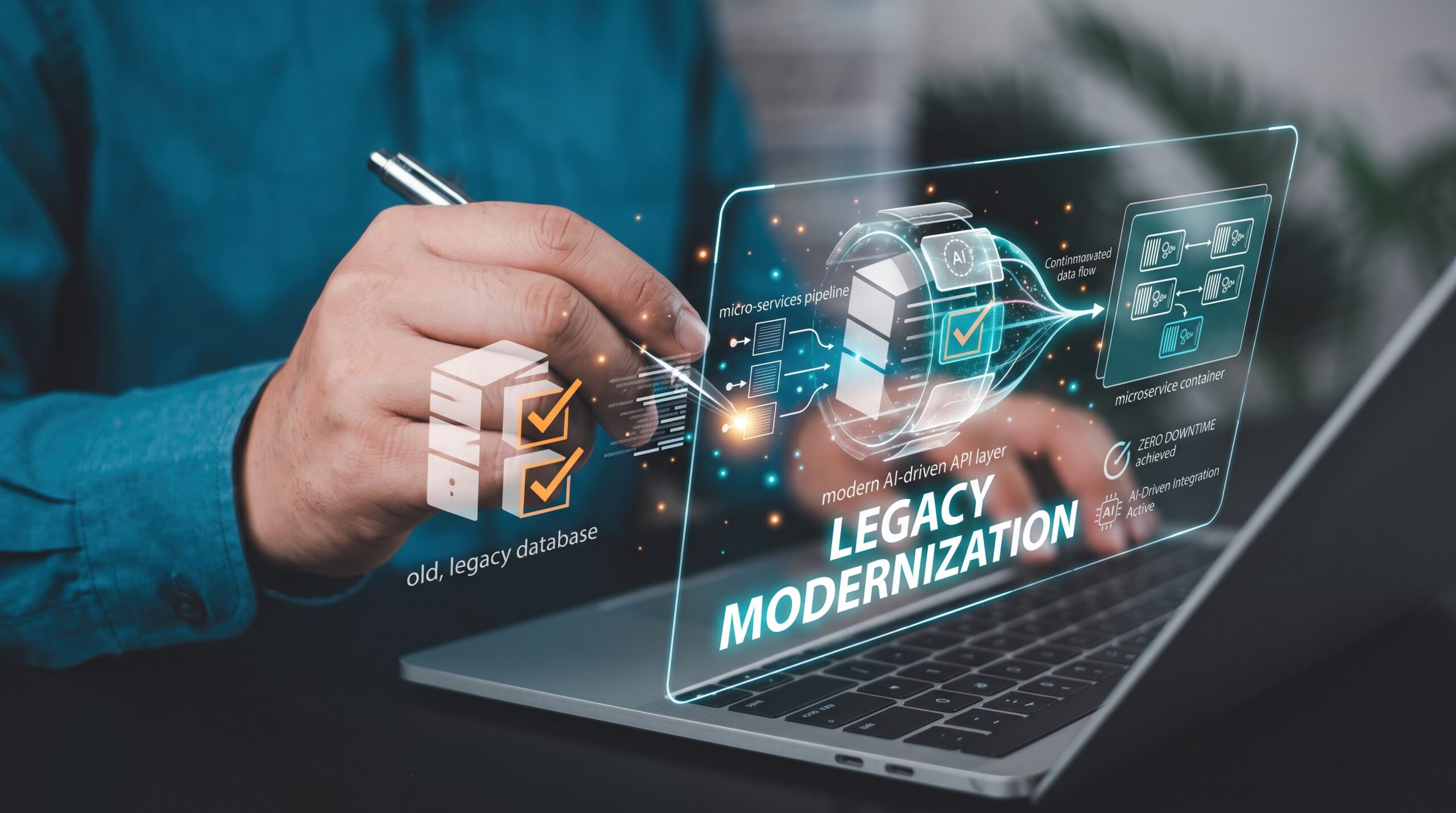
Legacy systems that cannot integrate with modern platforms become bottlenecks. API gateway wrapping places a translation layer between the legacy application and external consumers. New services interact with the gateway, and the legacy system continues operating as-is.
This approach unlocks integration capabilities that would otherwise require months of refactoring. It also creates a natural boundary for the strangler fig pattern, where new microservices gradually replace legacy functionality behind the same API contracts.
4. Security hardening and compliance patching
End-of-life infrastructure accumulates unpatched vulnerabilities. According to McKinsey research on technical debt, CIOs estimate that tech debt amounts to 20 to 40 percent of their entire technology estate value. Security hardening addresses the most critical exposure points without triggering architectural changes.
Targeted interventions include network segmentation, encrypted data-at-rest layers, WAF deployment, and automated vulnerability scanning. These measures reduce the attack surface and maintain regulatory compliance while the broader modernization effort takes shape.
5. Knowledge capture and documentation
The talent clock is the most underestimated risk in legacy stabilization. Engineers who built and maintained these systems are retiring. When they leave, undocumented business logic disappears with them. Knowledge capture creates structured documentation of system behavior, dependencies, and decision rationale before that institutional memory is lost.
Gorilla Logic addresses this through Construct™ workflows that use AI to analyze legacy codebases and generate technical documentation in hours rather than weeks. This accelerated documentation preserves critical context and directly informs modernization architecture decisions.
6. Incremental performance optimization
Not every performance constraint requires rearchitecting. Database query tuning, caching layer introduction, connection pool optimization, and index rebuilds can extend the viable lifespan of a legacy system by years. These interventions target specific bottlenecks identified through the observability data from option two.
The aim is to make the system fast enough and stable enough to support business operations until its replacement is ready. Incremental optimization is the lowest-risk, lowest-cost stabilization option when the system architecture is fundamentally sound.
7. Dedicated stabilization engineering pods
For systems that need active engineering attention rather than passive maintenance, dedicated pods combine deep system knowledge with modern delivery practices. These teams handle bug fixes, minor feature requests, performance tuning, and incident management as a unified function.
Gorilla Logic’s AI-enabled engineering pods embed directly with client teams to deliver this kind of sustained stabilization. With nearshore alignment and AI-accelerated workflows, these pods reduce engineering effort by 30 to 80 percent while maintaining the operational continuity that enterprise systems demand.
8. Automated regression testing
Legacy systems that lack test coverage become change-resistant. Every patch or configuration update carries unknown risk. Automated regression testing builds a safety net around the existing codebase, enabling changes without fear of cascading failures.
Gorilla Logic’s Intelligent Quality Engineering practice uses AI-assisted test generation to create coverage rapidly, even for undocumented systems. This approach cuts manual QA effort by 35 to 45 percent and gives stabilization teams the confidence to make necessary changes without delaying the broader modernization timeline.
How to choose the right stabilization approach
The correct legacy system support option depends on three evaluation criteria: business criticality, technical debt severity, and modernization timeline. Systems processing high transaction volumes with a modernization horizon beyond 18 months typically need managed maintenance plus observability. Systems blocking integration with new platforms need API wrapping first.
The decision is rarely binary. Most enterprises deploy two or three of these options in combination, tailored to each application in their portfolio. What matters is choosing deliberately, based on a structured assessment of risk and business impact, rather than defaulting to a single approach across the entire estate.
Gorilla Logic works with technology leaders to think through exactly these trade-offs, mapping portfolio health, identifying the highest-risk systems, and sequencing stabilization and modernization actions against business priorities. If you are weighing how to keep critical systems stable while a modernization roadmap takes shape, a conversation with our engineering team is a good place to start.
FAQs about Legacy System Support Options Before Modernization
What is legacy system stabilization?
Legacy system stabilization is the practice of maintaining and strengthening aging applications so they remain performant and secure while your organization executes a longer-term modernization strategy. It includes activities like managed maintenance, security patching, and observability installation.
When should you stabilize instead of modernize?
Stabilization makes sense when the system still delivers business value, the modernization timeline exceeds 12 months, and the organization cannot absorb the operational risk of a simultaneous overhaul. It protects revenue during the transition period.
How does API wrapping help legacy systems?
API wrapping places a modern interface layer over legacy applications, allowing new services to connect without modifying the underlying code. This unlocks integration capabilities and creates a foundation for gradual modernization using the strangler fig pattern.
What are the risks of not stabilizing legacy systems?
Unstabilized systems accumulate security vulnerabilities, lose institutional knowledge as engineers retire, and degrade in performance. These compounding risks increase the cost and complexity of eventual modernization and can cause operational failures during the transition.
How does Gorilla Logic support legacy system stabilization?
Gorilla Logic deploys AI-enabled engineering pods that embed with client teams to handle maintenance, documentation, testing, and performance optimization. Construct™ workflows automate legacy codebase analysis, reducing engineering effort by 30 to 80 percent while maintaining system stability.
Can you stabilize and modernize at the same time?
Running stabilization and modernization in parallel is the recommended approach for most enterprises. Stabilization keeps current systems operational while modernization teams build replacements incrementally. The two efforts share data from observability tools and documentation, making the overall program more efficient.