- Mobile NFC: A Practical Use Case Part I
- Mobile NFC: A Practical Use Case Part II



The first part of this series introduced NFC Technology and current capabilities of mobile NFC on the two most used platforms, Android and iOS. In this second part of the series, a proof of concept app has been built on Android to demonstrate possible usages of a mobile app NFC capable, as well review Android capabilities in terms of using NFC.
Today, devices such as cell phones allow users to buy products from the comfort of their living room couch without having to go to a computer to make the purchase. They are also able to learn valuable information about users to inform them about products they are interested in, helping them make a real investment rather than just a simple purchase.
Based on this premise companies can improve the interaction human-product in different fields such as retail stores, authentication and stocking control.
For example, a customer enters into a store and could get more information about a product by scanning a tag that triggers an app.
NFC tags may contain something as simple as a SKU code or more detailed information such as a JSON text. NFC Tags can contain this SKU as a MIME Type text/plain message (Type Name Format TNF 2).
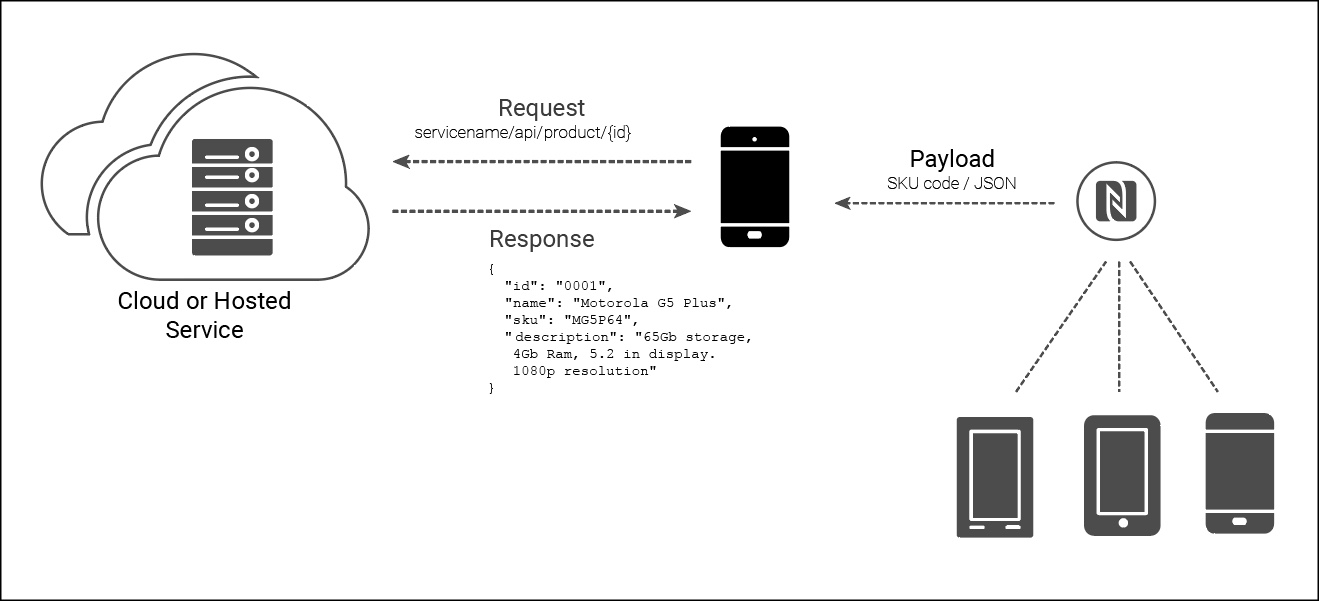
The mobile device will have an application installed that will interpret the payload and contact a web service in order to obtain the product information.
The service will gather the information and send back the response to the mobile device showing all the data related to the specific product.
Derived from this study case, the use of this technology can spread to other functionalities such as display similar merchandise suggestions in the event the current product is not available, allow retailer store employees’, allow customer and employees to prepare an in-store shopping cart to improve timeouts when paying or finding the right style/size/color for the current product.
The NFC forum introduced their first standardized technology architecture and standards for NFC compliant devices in June 2006. This included the structure for writing data to tags or exchanging it between two NFC devices called NDEF (NFC Data Exchange Format), and three Record Type Definitions (RTD). A so-called NDEF record can contain multiple different RTDs. An RTD is an information set for a single application, as an RTD may only contain isolated information such as text, a URI, a business card or pairing information for other technologies. The different RTD specifications are available on the NFC Forum website.
There are four basic tag types that have been defined. These are given designations of 1 to 4, and each has a different format and capacity.
The advantage of keeping the NFC tags as simple as possible is that they may be deemed to be disposable in many instances and often embedded in posters, for example, that may only have a short life.
The different NFC tag type definitions are as follows:
Type 1 and 2 tags are clearly very different from type 3 and 4 tags, with different memory capacity and makeup. For this reason, it is likely that there will be very little overlap in their applications.
Type 1 and type 2 tags are dual state and may be either read/write or read-only. Type 3 and Type 4 tags are read-only, and data is entered either at manufacture or by using a special tag writer.
There is a wide variety of NFC Tags that can store data, from simple links or product codes, to vCards (Virtual Contact File). Taking the example described before for granted one of the suggestions could be storing an SKU or product code on the NFC Tag. It should be pointed out that, in order to implement this approach, the technical team should first identify how the database is structured in order to determine if the current product code works for the solution in mind.
The NFC NTAG213 Standard is a good choice to implement the solution. This type of NFC Tag supports 128 to 144 bytes, enough for a standard product code, and is suitable for general use, in addition to being secure (32-bit password protection to prevent unauthorized memory operations) and available in several shapes, such as ties for use on <assets like accessories and clothing.
After thorough research, among mobile operating systems Android is the best platform to use NFC technologies, based on the following aspects:
 Click here for a more extended list.
There are several Android apps that perform NFC tag read/write operations such as NFC Tools and NFC Trigger. For bulk writing, there are options such as NFC Bulk Writer. Also, there are different external NFC writers that can be used with a computer.
]]>