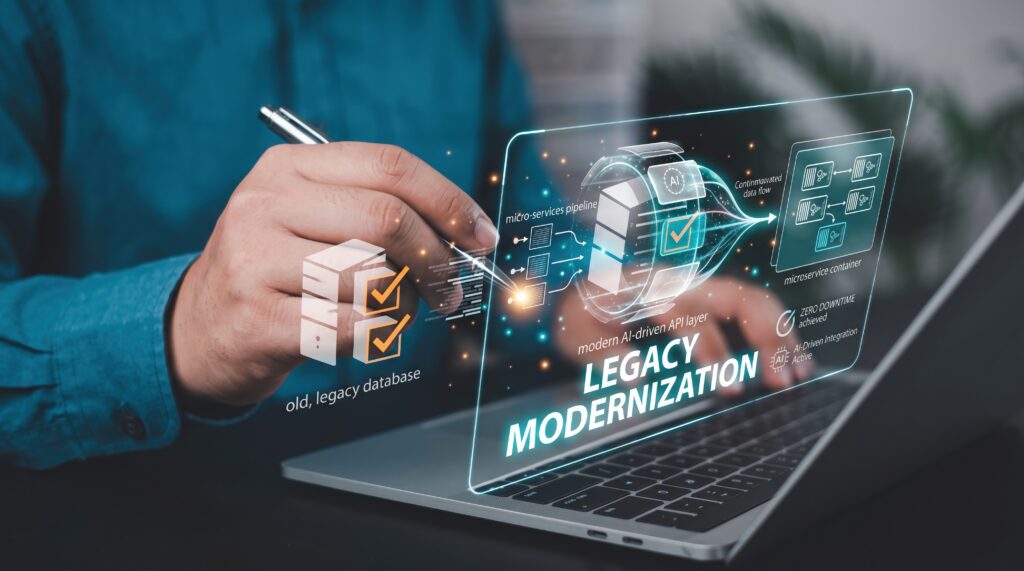


Retail platform modernization usually gets framed as a technical inevitability. Legacy systems age, vendors sunset products, and new capabilities get harder to bolt on. Eventually modernization feels unavoidable.
But plenty of retail and CPG organizations modernize repeatedly without ever feeling modern. The reason is that modernization gets treated as a technology replacement exercise rather than a change in how engineering, delivery, and leadership operate together.
That gap is getting more expensive. Deloitte’s 2026 consumer products outlook argues that long-accepted priorities like breadth, scale, and optimization are now being challenged by a need for focus, speed, and agility, with drivers like deglobalization and AI hitting the industry quickly. Deloitte frames the shift bluntly: in a less stable world, nimble beats optimal, and companies over-optimized for scale will likely have a harder time competing. Retailers that succeed don’t start with rewrites or replatforming. They start by improving flow, predictability, and visibility across their engineering systems, and by giving leaders the information to act on what those systems reveal.
The hidden cost of legacy retail platforms
Legacy platforms rarely fail all at once. They impose friction quietly and consistently across the organization. Common symptoms include long lead times for even small changes, high-risk releases during peak seasons, heavy reliance on manual processes and workarounds, difficulty onboarding new channels or partners, and limited visibility into where delivery actually slows down.
Over time these issues compound. Teams become cautious, innovation slows, and the platform turns into something the organization protects rather than evolves. From an executive perspective, the cost goes beyond technical debt to missed opportunity and reduced confidence in execution.
Why traditional modernization efforts stall
Retail modernization initiatives often begin with urgency and executive sponsorship, then stall or underdeliver. The patterns are consistent.
Technology changes, but the way work flows doesn’t. New platforms get introduced while the same delivery bottlenecks remain. Cycle time doesn’t improve because the underlying system of work hasn’t changed.
Complexity moves instead of shrinking. Monoliths get replaced with distributed systems, but without standards or ownership, complexity increases rather than becoming more manageable. This is the same trap Deloitte identifies at the organizational level, where functional and geographic silos create complexity and reinforce a culture that is risk-averse and consensus-driven. Structural complexity and platform complexity feed each other.
Fragmentation from acquisitions is a common source: when Gorilla Logic worked with a home services marketplace that had unified several acquired properties under one brand, years of acquisitions had left fragmented user journeys spread across legacy platforms. The work there was to consolidate that sprawl into a unified foundation, not to add another layer on top of it.
Leadership loses ongoing visibility. Executives receive milestone updates instead of flow metrics, so when issues surface they appear suddenly, often late in the process.
Modernization tends to fail when it focuses on what gets built rather than how the organization builds and evolves systems.
Start with metrics, not architecture
Successful retail platform modernization begins with measurement. Before making major technology decisions, leading organizations establish clarity around where work queues up, which changes take the longest to deliver, where quality degrades under pressure, and which systems create the most downstream friction.
This follows a core principle: metrics precede acceleration. When leaders understand flow efficiency and constraints, modernization decisions become grounded, incremental, and far less risky. It also creates the conditions AI needs to help.
Deloitte notes that simpler, flatter structures and end-to-end processes bring the data that fuels AI into centralized locations, letting insights move more smoothly across the organization. Clean flow and clean data are the same project.
Engineering fundamentals are the foundation
Retail platforms modernize successfully when engineering fundamentals get addressed early and consistently.
API-first and integration discipline. API-driven platforms reduce coupling between systems and teams, which enables incremental modernization without disrupting the entire ecosystem.
Incremental decomposition over big-bang rewrites. Breaking platforms into well-defined capabilities lets organizations modernize continuously while still delivering business value.
Predictable delivery pipelines. Modern platforms require modern delivery. Automated testing, CI/CD, and clear release ownership are essential to reducing risk, especially during high-volume retail periods.
These fundamentals don’t slow modernization down. They make it survivable.
Why engineering managers anchor the effort
Retail platform modernization is usually sponsored at the executive level and executed by engineers, but engineering managers are the ones who make or break it.
Strong engineering managers translate modernization goals into delivery reality, balance technical change against business continuity, own quality and flow and predictability across teams, and surface constraints early while they’re still manageable.
This matters more now that growth and headcount are separating. Deloitte reports that investors no longer read announced layoffs as trouble or hiring as growth, and instead expect to see sharply increased productivity. For engineering organizations, that pressure lands on how well leaders can improve throughput without simply adding people.
Without empowered engineering managers, modernization becomes reactive. With them, it becomes controlled and repeatable. That’s why Gorilla Logic focuses on arming engineering leadership rather than simply adding capacity. Sustainable modernization requires leaders who can see the system clearly and act decisively.
What modernized platforms actually enable
When retail platform modernization is done well, the benefits reach well beyond technology. Retail organizations get faster time-to-market for new initiatives, safer releases during peak seasons, better collaboration between engineering and product and business teams, and greater confidence in scaling channels and regions.
The home services marketplace shows what that looks like in practice. Working against the client’s roadmap, Gorilla Logic delivered a fully refactored, rebranded web and mobile experience in under six months, and payment volume grew twentyfold within a year of launch. Embedded financing and payment flexibility opened new revenue channels, a Stripe-integrated portal cut activation time for service professionals, and the new architecture established a foundation for future services, promotions, and community features. The platform stopped being a constraint and became the thing growth was built on.
The competitive stakes are shifting fast. NRF’s 2026 outlook points to smart consumer agents and autonomous supply chains as the breakthroughs that defined 2025, and expects the effects to keep compounding.
Deloitte adds a concrete signal of how quickly buying behavior is moving: it reports that referral traffic from ChatGPT and other AI chats already accounts for 15% to 20% of total referrals for some retailers. Platforms that can’t support new channels, partners, and agent-driven commerce will feel that constraint directly. Retail platform modernization succeeds when it improves the organization’s ability to change, not just the tools it uses.
Executive questions that reveal readiness
For retail leaders evaluating modernization efforts, a few questions quickly expose whether the organization is ready. Can we deploy changes safely during peak demand? Do we understand where delivery slows down today? Are modernization efforts incremental or all-or-nothing? Do engineering managers have real ownership and visibility?
If these questions are hard to answer, modernization risk is likely higher than it appears.
How Gorilla Logic approaches retail platform modernization
At Gorilla Logic, we help retail and CPG organizations modernize platforms by focusing on systems, flow, and leadership rather than technology transitions alone. Our approach emphasizes engineering fundamentals before acceleration, incremental modernization that delivers value continuously, clear metrics that guide decisions, and empowered engineering managers who own outcomes.
We work alongside internal teams to strengthen both platforms and operating models, so modernization creates lasting capability instead of temporary relief.
Executive takeaways
Retail platform modernization is not about replacing legacy systems as fast as possible. It’s about improving the organization’s ability to deliver change predictably and confidently. The leaders who succeed focus on visibility before velocity, flow before features, and leadership enablement before tooling.
Modernization done this way updates more than technology. It changes how the organization operates.