

How PE-backed engineering teams are using nearshore engineering in Costa Rica and Colombia to close the gap between where the product is and where it needs to be at exit.
Something has shifted in the way PE operators talk about nearshore engineering. A few years ago, the conversation started and ended with cost. Now, when I sit down with operating partners, the first thing they bring up is velocity, and specifically, whether their portfolio company can ship fast enough to hit the milestones that justify the exit multiple they have in mind.
That shift is not cosmetic. Cost and velocity are fundamentally different problems with fundamentally different solutions. And if you are still running the old playbook (optimize cost per engineer, minimize spend, report the savings to the board), you may be solving the wrong problem entirely.
The Old Offshore Playbook Had Its Moment
For a long time, the offshore model made perfect sense. Large, stable codebases. Well-defined requirements. Minimal need for real-time collaboration. You could absorb a 10- to 12-hour time zone gap because nothing was moving fast enough to feel the friction.
PE-backed software companies in active transformation need a different nearshore engineering model entirely. Consolidating platforms after a bolt-on acquisition. Rebuilding an architecture that has to scale to the growth thesis. Layering AI capabilities into a product stack that was built before any of this existed. These are not stable-maintenance problems, they require tight feedback loops, shared context, and engineers who are genuinely part of the team.
BDO’s 2026 PE industry analysis confirms what operating partners are already experiencing: digital transformation expertise is now viewed as essential at the portfolio level, not a nice-to-have. How you structure engineering talent is part of that evaluation, whether you are entering a deal or preparing to exit one.
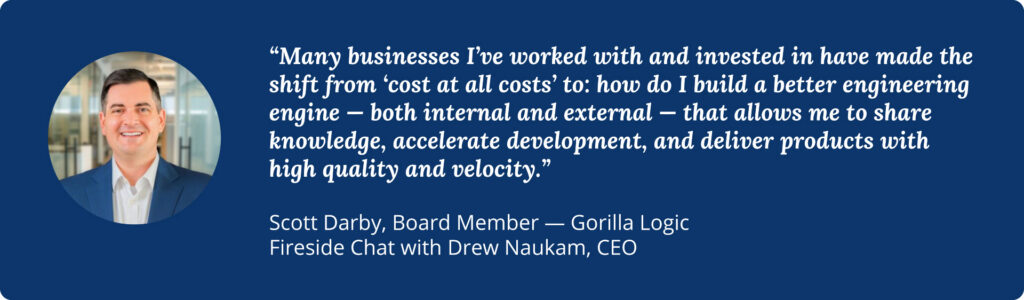
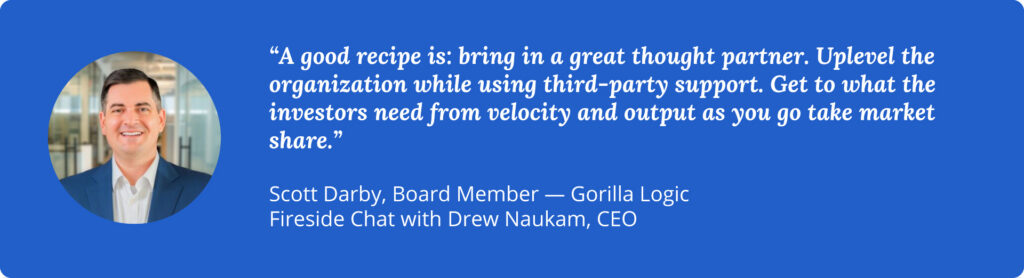
Scott Darby is describing something that sounds simple but is actually hard to execute: an engineering organization, internal and external, that is built to deliver at the pace the hold period demands, not one that is tuned for the lowest invoice total.
Why Costa Rica and Colombia — and Why It Matters
The question is not just whether to nearshore but where, and the answer matters more than people expect, especially on a defined timeline.
What a PE-backed company needs during a 24- to 36-month hold period is time zone alignment, English fluency, genuine cultural fit with the US team, a mature talent market, and, critically, low attrition. Continuity in your engineering partner is not a soft benefit. It means institutional knowledge stays intact through the hold. The engineers who started the program are the ones who can explain the architecture when the data room opens.
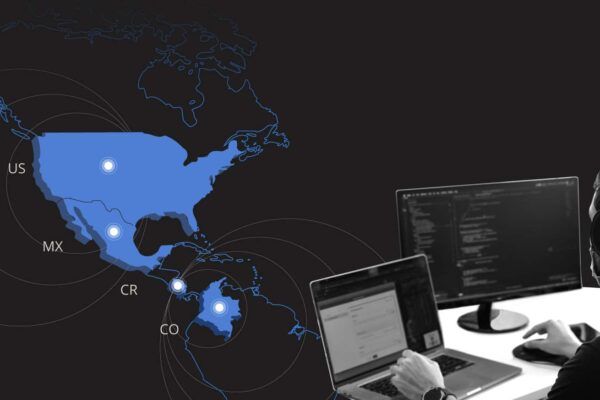
Costa Rica is the most mature nearshore engineering market in Latin America. The talent ecosystem is established, engineers are fluent and culturally aligned with US teams, and the labor market rewards tenure. Colombia, specifically Bogotá and Medellín, is the fastest-growing market in the region, with deep talent pipelines, strong technical universities, and an expanding track record with enterprise US clients. Medellín in particular has earned its reputation as the Silicon Valley of Latin America.
We run tenured engineering centers in both markets. Engineers want to work there, and they stay. That sounds like a soft claim until you are 18 months into a hold and the team on your product actually knows the codebase, and the team that built the first version is the same one shipping the next release.
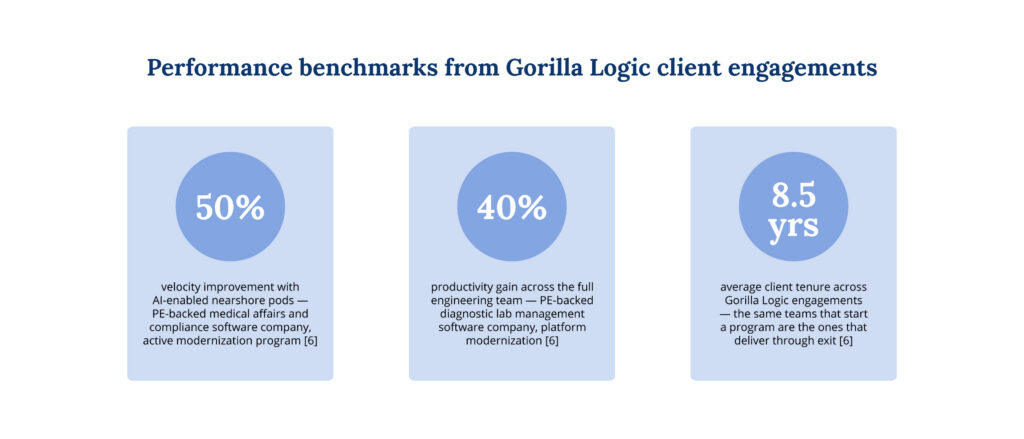
The Nearshore Engineering ROI PE Operators Actually Want to Discuss
There are real savings in Latin America compared to US engineering talent, and there is nothing wrong with naming that directly. A PE operating partner looking at a portfolio company with $4M in annual engineering spend concentrated in high-cost US markets can shift a meaningful portion of that delivery to Costa Rica or Colombia, keep full US time zone alignment, and see a tangible EBITDA impact. That is a legitimate board-level lever.
What makes it different from traditional offshore arbitrage is the coordination tax. Analysis of PE-backed engineering hiring patterns through 2026 confirms something we see in our own engagements: nearshore developers in Latin America deliver less managerial overhead and greater predictability, and the flexibility to scale teams up or down quickly as hold period priorities shift. The cost savings are real. The 10- to 12-hour coordination penalty is not.
Time Zone as a Delivery Variable
When operating partners and PE-backed CTOs ask about nearshore today, the first substantive question is usually about time zone, and for good reason. It is not a preference item; it is a structural variable that determines how fast the team can move.
Full US time zone overlap means a sprint that starts Monday morning with a shared standup finishes Friday afternoon with shared accountability for what shipped. Blockers surface in real time. Pull requests get reviewed the same day. A design question in the morning gets an answer before the end of the day. For a team running at the pace a PE-backed company needs, that cadence is the foundation of a functional engineering partnership.
Research tracking PE-backed engineering teams is direct on this: the difference between companies that adapt quickly and those that fall behind is not talent or funding, it is engineering velocity. If a company is 18 months into the hold period and the product roadmap is running 6 months behind, closing that gap is not an incremental improvement. It determines what the exit conversation looks like.
How Nearshore Engineering Builds PE Portfolio Capability, Not Dependency
The most effective engagements we run are not permanent augmentation. They follow what Scott Darby calls a knowledge surge model: rotate in specialized talent, run it alongside the internal team, and build capability that carries forward after the engagement winds down.
A typical PE-backed company has a competent internal engineering team that simply has not yet shipped at AI-enabled velocity. They have not built AI-accelerated delivery workflows. They do not have a measured engineering maturity framework with cycle time baselines. A nearshore partner brings that capability into the environment, works alongside the internal team, and, if the engagement is structured well, the internal team absorbs how it works: new tooling, new patterns, better ways of working. When the partner scales back, the internal team is operating at a higher level than when the engagement started.
Gorilla Logic Perspective
This is the model Gorilla Logic is built around. Our Gorilla Logic Construct™ workflows — delivery-tested AI acceleration framework & patterns built from real client engagements — get embedded into the client environment with full client IP ownership. No licensing fees. No platform lock-in. The internal team walks away with the capability, not a dependency.
Comparing the Models
The trade-offs worth understanding are not just about cost. Time zone, attrition, AI delivery maturity, and how the engagement reads at exit all factor in.
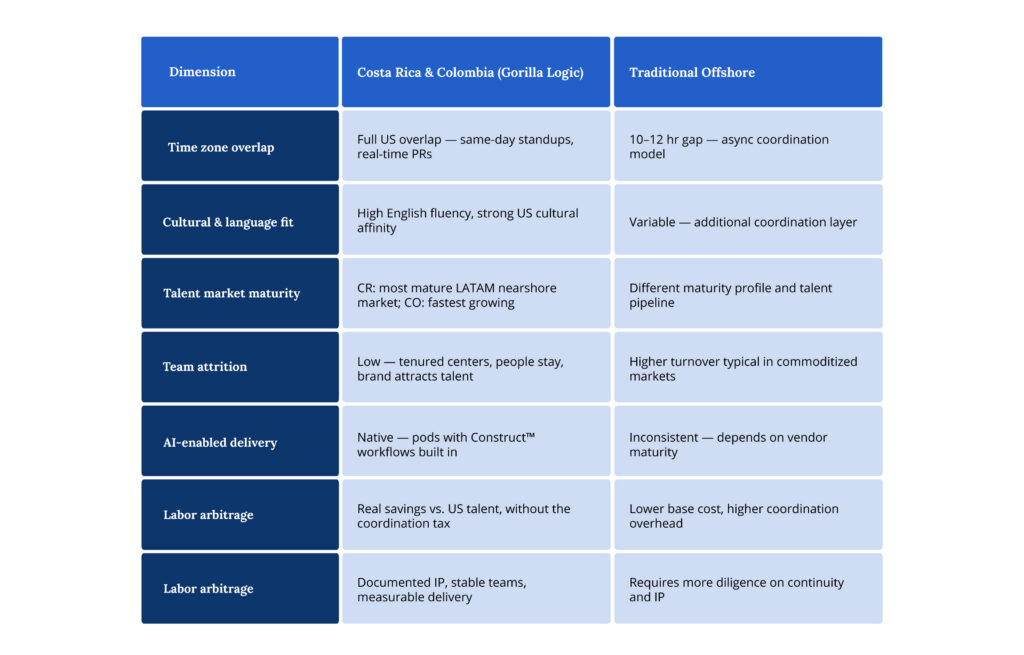
Salary reference: Terminal.io Remote Software Engineer Salary Insights, 2026
Nearshore Engineering Strategy in the PE Diligence Process
One of the clearest signals that this conversation has matured is where nearshore strategy appears in the diligence process. Analysis of PE deal flow through 2026 shows nearshoring influencing assumptions and operating models from the start of the hold, not as a post-close afterthought. Buyers are paying attention to how engineering organizations are structured: documented IP, stable teams with low attrition, measurable delivery metrics, and no platform lock-in all factor into how a portfolio company reads on the way out.
The attrition point carries particular weight. A nearshore engineering center with low turnover and a strong employer brand gives you something that is genuinely hard to replicate: the team that built the product is still there when exit conversations start. They can speak to the architecture, explain design decisions, and walk a buyer through the codebase with confidence. In a data room, that continuity matters.
Structuring It to Last Through the Hold
The structure that holds through a hold period is not complicated: continuity, measurable delivery, and IP that belongs to you.
Nearshore in private equity has grown into a value creation lever that shows up in EBITDA, in exit multiples, and in how buyers read the engineering organization when they open the data room. The operating partners and CTOs building that case from the start of the hold period are the ones with the most to show for it at the end.
If you are building out a PE-backed engineering organization with nearshore as part of the strategy, Gorilla Logic has the delivery model, the market presence in Costa Rica and Colombia, and the PE-specific experience to make it work within your hold period timeline. See how we approach private equity engineering or talk to someone on our team directly.